Your baby has been communicating with you since before they could say a single word. That cry that pulls you out of sleep at 2 a.m.? Communication. The way their face lights up when you walk into the room? Also communication. Long before a baby says "mama" with intention, they are already telling you everything they need, just in a language that takes a little time to learn.
This blog is a parent-friendly guide to the baby talking timeline: what happens when, what supports speech along the way, and what is worth paying attention to. It is not a diagnostic tool, and it does not replace a conversation with your paediatrician. Think of it as a starting point, something to read with curiosity, not anxiety.

What To Keep In Mind
Every child develops at their own pace. The milestones in this guide are broad ranges, not deadlines. Some babies say their first word at 10 months. Others take until 14 or 15 months. Both can be completely typical.
This blog is general information. If you have specific concerns about your child's hearing, speech, or development, the right person to speak to is a qualified professional — a paediatrician, audiologist, or speech-language pathologist. The sooner you ask, the better, not because something is necessarily wrong, but because early attention always helps more than waiting.
How Babies Begin to Communicate
Communication begins before birth. Babies in the womb respond to stimuli — movements that shift after the mother eats, and to sounds and sensations. Many mothers notice their baby becomes more active after a meal.
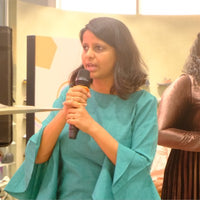
As Dr. Neha Banerjee, Audiologist and Speech-Language Pathologist, explains on the Loopie podcast When Do Babies Start Talking, these early responses are the first signals of a baby communicating with the world around them.
After birth, that arc continues. Crying comes first; it is a baby's earliest and most effective tool for expressing need. From there, the journey moves through facial expressions and eye contact, cooing, babbling, something called jargon, first meaningful words, and eventually sentences. Each stage builds on the one before it.
One Thing Worth Knowing Early
Language comprehension develops ahead of expressive speech. Babies understand far more than they can say. A 10-month-old who cannot yet speak may already know exactly what "Come here" means. That gap between understanding and speaking is completely normal and, in many ways, is where a lot of the groundwork gets laid.
There is also a stage that parents often do not have a name for. Before babbling turns into real words, babies produce what sounds like confident, expressive speech — rising and falling in tone, mimicking the rhythm of conversation, but without actual words. This is called jargon, and it is a healthy, normal part of speech development.
If your baby sounds like they are having a very serious conversation in a language nobody else speaks, that is jargon. It means things are moving in the right direction.
Alongside jargon, babies also begin creating their own substitute words for things they cannot yet pronounce. "Mum-mum" for water, for example, or a sound that only your family knows means "give me that." This is not confusion; it is resourcefulness.
Children understand that everything has a name. Since they cannot produce the correct word yet, they invent one that works. Over time, those substitute words are gradually replaced by the real thing.
And before any of this: babies spend a remarkable amount of time watching faces. They track lip movements while adults speak. They are, quite literally, studying how sounds are made, long before their mouths can make them. That early face-watching is not passive. It is preparation.

The Baby Talking Timeline: 0 to 24 Months
Children follow a natural progression in speech and language development, though the pace varies from child to child. Mayo Clinic's guide to language development milestones and the NIDCD's speech and language developmental milestones checklist offer detailed reference points. Here is what that timeline generally looks like:
0 to 3 months
Babies react to voices, quieten when spoken to, and begin making cooing sounds. They recognise their primary caregiver's voice. Their cries start to take on different patterns for different needs.
4 to 6 months
Babbling begins. Babies experiment with sounds, especially those that start with "p," "b," and "m", and respond to changes in tone of voice. By around 6 months, most babies can recognise the basic sounds of their native language. They notice music. They laugh.
7 to 12 months
This is when babbling becomes more varied and speech-like. Babies use longer and shorter groups of sounds, babble to get attention, and begin communicating with gestures: waving, pointing, holding out their arms. They start to understand simple words and commands. By the first birthday, most babies have at least one or two meaningful words, typically "mama" or "dada" used with intention, not just as sounds.
That last part matters. Dr. Banerjee is clear on this: saying "ma-ma-ma" during babbling is not the same as a first word. A first word is one the baby uses intentionally, with understanding — seeing their mother and saying "Mama" because they know who she is. That moment of association is the real milestone.
12 to 18 months
Vocabulary begins to grow. Babies learn names of people, common objects, and body parts. They follow simple commands, point to things they want, and bring objects to show you. Around 18 months, many children begin combining two words: "Papa gone," "Open box," "More milk."
HealthyChildren.org, published by the American Academy of Paediatrics, notes that between 18 and 24 months, most toddlers are adding roughly one new word per week.
18 to 24 months
Two-word phrases become more frequent. Sentences start forming. By age 2, most children can say around 50 or more words and are understood by familiar adults about half the time. After 24 months, speech typically accelerates; the groundwork laid in these early months starts to show.

What Parents Can Do to Support Speech
The most important thing parents can do is also the simplest: talk. Not at your baby — with them. There is a difference.
Dr. Banerjee's advice on this is practical and worth keeping: Do not track every word or milestone every single day. That kind of constant monitoring creates anxiety — and babies are perceptive. They feel the tension. Instead, celebrate the small moments. A new sound. A new gesture. An expression that lands exactly right.
What actually helps:
-
Narrate your day. Cooking, bathing, walking to the window; describe it. Not in a performance, just in conversation. "Let's see what's outside. Oh, there's a crow. Look at that."
-
Use expressive speech. Dr. Banerjee is specific about this: your voice needs variation. Rising tone, emphasis, feeling. A flat, monotonous voice does not hold a baby's attention. Speak like you mean it.
-
Skip the baby talk. You do not need to distort your voice or use made-up syllables. Speak clearly, in your normal manner. The expressiveness comes from tone and facial engagement, not from sounding funny or kiddish.
-
Respond to everything. When your baby babbles, respond. When they point, acknowledge it. When they gesture, name what they are pointing at. Every back-and-forth exchange is a conversation, even when only one side has words.
-
Sing and read. Songs and rhymes build familiarity with rhythm, sounds, and repetition. Reading aloud, even to a very young baby, introduces vocabulary and the idea that words carry meaning.
-
Play. Become a child with them, says Dr. Banerjee. Whether it is blocks, a ball, or a pot from the kitchen, play while talking. Children at this age learn through interaction, not instruction.
One of the most consistent findings across research and real-world experience is how much grandparents contribute. Akriti Gupta, Founder of Loopie and the podcast host, shared this when reflecting on her own daughter's early months: it was her mother-in-law, her daughter's dadi, whom she credits most. "Her dadi would continuously talk to her."
The sustained, affectionate, one-on-one conversation that grandparents often provide turns out to be one of the most natural forms of language stimulation there is.
Peer interaction also matters more than many parents expect. Akriti noticed that when an older cousin stayed with them for a few days, her daughter started trying new words and became noticeably more expressive.
Dr. Banerjee explains why: children are at ease around other children. They observe each other during play, imitate naturally, and pick up sounds and words without any effort because they are having fun. Learning while relaxed is learning that sticks.

Specifically at 12 Months: What Helps Right Now
The 12-month mark tends to bring a particular kind of parental anxiety, a feeling that the clock is ticking. It helps to know what is actually expected at this stage and what genuinely supports development.
By 12 months, most babies are using at least one or two meaningful words, responding to their name consistently, following simple commands, and communicating through gestures. They should also be taking turns "talking", listening when you speak, then babbling when you pause. That back-and-forth is a big deal. It is the structure of conversation, even before the words arrive.
What helps at this stage specifically:
Point and name things during everyday routines. Bath time, mealtimes, a walk around the house — all of these are chances to introduce vocabulary in context. When your baby points at something, tell them what it is.
When they try to say something, model it back correctly. If they say "open box," you say "Oh, you want me to open the box?" They hear the complete sentence. Their attempt is validated. The chain of words gradually gets longer.
This is how sentences develop, not through drilling, but through conversation that meets the child where they are.
Multilingual Homes and Baby Speech Development
In most Indian households, more than one language is part of daily life. A child might hear Hindi at home, Tamil with grandparents, and English at playgroup. For many parents, a worry follows: is all of this confusing my baby?
The short answer, backed by peer-reviewed research published in Learning Landscapes via PubMed Central, is no. Bilingual children are not more likely to have speech delays or language disorders than monolingual children. When vocabulary is counted across both languages, not just one, bilingual children show comparable language knowledge to their monolingual peers.
Dr. Banerjee explains this with a straightforward example: a Bengali family living in a Hindi-speaking city. The child hears Bengali at home and Hindi outside. Their first words may appear in the dominant home language. But both languages are being absorbed in parallel. Children are capable of managing this without confusion.

She also addresses the multilingual myth directly: simply growing up in a home with more than one language does not cause speech delay. What matters most is the quality and quantity of interaction in any language. A child who hears rich, engaged conversation in two languages is doing well.
One important nuance from Dr. Banerjee: the advice to focus on a single language comes up sometimes in the context of speech therapy — when a child already has a diagnosed delay and a structured approach is needed. That is a therapeutic strategy, not a general parenting rule.
Different languages also shape which sounds a baby produces first. Lip sounds — "M," "P," "B" are learned earliest because babies can see lip movements clearly while watching adults speak. Sounds made further back in the mouth — "K," "G" come later.
The most complex sounds, like "R," which requires significant tongue movement, may not be fully mastered until 4 or even 5 years of age. A toddler who cannot yet roll their "R" is not behind. They are on track.
When Speech Slows, Stops, or Changes
Some variation in pace is normal. What is worth paying attention to is regression — when a child who was already combining words or communicating consistently suddenly goes quiet, or noticeably pulls back.
Dr. Banerjee explains that if a child had reached a speech milestone and then stops, it deserves attention. The cause could be physical, for example, a head injury affecting areas of the brain involved in speech, or emotional. A significant change, a stressful event, or even a disruption in routine can affect development at this stage. The brain is developing rapidly, and it is responsive to what happens around it.
It is also worth knowing that hearing loss can develop after birth. Dr. Banerjee raises meningitis as a specific example — an infection that affects the membranes surrounding the brain, can damage the inner ear, and consequently impact speech development. A vaccine is available and recommended; speak to your paediatrician about your child's vaccination schedule.

On screen time
The concern is not really about screens themselves. It is about what screens replace. Dr. Banerjee explains it this way: real communication is two-way. Someone speaks, someone listens, someone responds. A screen does not wait for the child's answer. It keeps going regardless. That absence of back-and-forth is what makes passive screen exposure a poor substitute for conversation.
If screens are part of your child's day, and for most families they are, the difference is in how they are used. Watching together, singing along, pointing at things on screen, asking questions: these turn a passive experience into an interactive one. Handing a child a device and walking away is when the opportunity is lost.
A preliminary study reported by PBS NewsHour, based on research from the Hospital for Sick Children in Toronto, found an association between increased hand-held screen time and expressive speech delay in toddlers. The researchers themselves noted this does not prove cause and effect, but the finding points in a direction worth taking seriously.
Children's emotional environment shapes speech too. If you have noticed that your baby seems more withdrawn or less communicative during a period of change or stress at home, that connection is real. Speech does not develop in isolation from everything else going on.
For more on how emotional development and communication intersect in early childhood, Loopie's guide to understanding separation anxiety in babies is worth a read.
Why Hearing Screening Matters
Hearing is the foundation of speech. A baby learns to talk by hearing language — by absorbing sounds, rhythms, and patterns long before they produce them. If hearing is compromised, speech development is affected too.
In India, the government has taken steps to ensure that every newborn undergoes a hearing screening before being discharged from the hospital. The standard test used is called the OAE — Otoacoustic Emissions test. It is quick, painless, and does not require the baby to respond or participate in any way. It checks whether the cochlea — the hearing organ inside the inner ear is functioning as it should.
Some hearing conditions are visible at birth (such as when the outer ear has not developed typically), but inner ear problems are not visible externally. That is precisely why the OAE test exists; to detect what cannot be seen.
If hearing loss is identified early, there are effective interventions available. Hearing aids amplify sound for children who have some hearing capacity. Cochlear implants — devices that bypass damaged parts of the inner ear and directly stimulate the auditory nerve are used when loss is more profound.
Early identification means early intervention, and early intervention consistently leads to better speech and language outcomes.
If your child did not have a newborn hearing screening, or if you have any concerns about how they respond to sound, raise it with your paediatrician. Do not wait for the next scheduled visit.

When to Speak to a Doctor
HealthyChildren.org by the American Academy of Paediatrics, notes that speech delays are the most common type of developmental delay; roughly 1 in 5 children will learn to talk or use words later than their peers. Some of these delays are temporary and resolve with support. Others benefit from professional evaluation and early intervention.
Signs worth discussing with a paediatrician:
-
No babbling by 12 months.
-
No gestures (pointing, waving) by 12 months.
-
No meaningful words by 16 months.
-
No two-word phrases by 24 months.
-
Loss of previously acquired speech or language skills at any age.
-
Inconsistent response to their own name.
-
Appears to hear some sounds but not others.
That last point on the list — regression, or loss of skills already gained is the one Dr. Banerjee flags most consistently. If your child was speaking and has stopped, do not wait to see if it passes.
Dr. Banerjee's advice on seeking evaluation is worth quoting directly: getting your child assessed does not automatically mean something is seriously wrong. Sometimes the outcome is reassurance. Sometimes it identifies something that benefits from early support. In either case, the family benefits. Waiting rarely helps. Early action almost always does.
If your child is bilingual and a concern arises, Mayo Clinic's language development guide recommends seeking a bilingual speech-language pathologist who can assess both languages, because evaluating only one language gives an incomplete picture.
FAQs: Parents' Most Asked Questions On Baby Speech
When do babies start babbling?
Most babies begin babbling around 6 months, sometimes as late as 8 or 9 months. They repeat syllables like "ba-ba" or "ma-ma" without attaching meaning to them yet.
When should babies say their first words?
Most babies say their first meaningful words around 12 to 14 months. A meaningful word is one used intentionally — your baby sees you and says "Mama" because they know who you are, not just as a repeated sound.
What is jargon in baby speech?
Jargon is when babies produce streams of babble that mimic the rhythm of real speech without actual words. It sounds like your baby is having a full conversation. Normal, and typically appears between 7 and 12 months.
How many words should a 1-year-old have?
At 12 months, most babies have 1 or 2 meaningful words. By 18 months, around 10 to 15. By age 2, most have 50 or more. These are ranges, not rules.
Is it normal if my baby speaks less than other babies?
Very often, yes. Track your child's own progress over time, not against another child. Are they learning new sounds? Communicating more? That forward movement matters more than pace.
Will learning two languages delay speech in my baby?
No. Research published in Learning Landscapes via PubMed Central is clear: bilingual children are not more likely to experience speech delays. Quality interaction in any language matters most.
Do regional languages affect which sounds my baby produces first?
Yes, and it is completely normal. Babies learn the sounds they hear most. Lip sounds like "M," "P," and "B" come first. Complex sounds like "R" may not be fully mastered until 4 or 5 years, regardless of language.
Should I use baby talk or normal speech?
Normal speech, spoken expressively. You do not need to distort your voice or use made-up words. Variation in tone, genuine engagement, and facial expression are what actually hold a baby's attention.
Do songs and rhymes actually help?
Yes. They expose babies to rhythm, repetition, and sound patterns — all of which support language development. The enjoyment factor matters too; engaged babies learn more.
When should I get my child's hearing checked?
Every baby should have a hearing screening before leaving the hospital. If yours missed it, or if you have any concern about how your child responds to sound, speak to your paediatrician. Hearing is foundational to speech.
When should I speak to a doctor about speech concerns?
If there is no babbling by 12 months, no words by 16 months, no two-word phrases by 24 months, or any regression in speech already gained, raise it with your paediatrician. Around 18 months is a reasonable point to seek assessment if meaningful words are still absent.
Here's to Baby Chitter-Chatters!
Speech develops through daily life — the conversations during dinner, the songs in the car, the stories before bed. It does not require a curriculum. It requires presence. Akriti noticed this firsthand: the thing that made the most difference for her daughter was her dadi simply talking to her. Consistently, warmly, without agenda.
Most variation in speech timing is normal. If you notice genuine red flags: no babbling, regression, limited response to sound, a conversation with your paediatrician is always the right next step.
For more on early milestones, check our guide to managing baby sleep while travelling is a good read for parents on the move.