Deciding between a reversible vs. forward-facing stroller can feel confusing, especially when every forum has a different opinion, and most guides are written for parents in Western countries, not for someone dealing with India's terrains, tight apartment spaces, and the very real logistics of daily life here."
The truth is neither is universally better. The right choice depends on your baby's age, your lifestyle, and what your day actually looks like. This guide breaks it all down with research-backed and real parent experiences to keep it grounded.

What is a Reversible and Forward-facing stroller?
A reversible stroller (also called a parent-facing stroller or reversible handle stroller) has a seat that rotates 180°. Baby can face you, or face the world; you choose. Most are designed to work from birth through toddlerhood.
A forward-facing stroller has a fixed seat direction. Baby always faces outward. These are typically lighter, more compact, and more affordable.
One important thing to know upfront: Reversible does not automatically mean newborn-safe. For a baby under 6 months, the seat must recline almost flat — ideally 170–175°. Always check this before buying, regardless of what the box says.
The Science Behind Stroller Direction (And Why It Matters More Than You'd Think)
In 2008, developmental psychologist Dr. Suzanne Zeedyk conducted the first-ever study on how stroller direction affects babies, commissioned by the National Literacy Trust (UK) and funded by the Sutton Trust. It involved over 2,700 parent-infant pairs observed in real life, plus a smaller experimental study of 20 babies.
The findings were useful — particularly for understanding what the early months look like."
Parents using face-to-face (parent-facing) buggies were twice as likely to talk to their baby — 25% compared to just 11% in the away-facing group. In the experimental portion, half the babies laughed while in the parent-facing position. Only one laughed while facing away.

The researchers also found that babies in away-facing strollers showed slightly different heart rates and sleep patterns, suggesting they may experience more stress in that position, particularly relevant for newborns who can't yet regulate their own emotions.
This is specific to the newborn and early infant stage when babies can't yet regulate their own responses and rely entirely on familiar faces for comfort. As babies grow and develop, that picture changes quite a bit.
As Lewisham Children & Family Centre summarises: "Most brain development occurs between birth and age two. Children's early communication skills are regarded as the single best predictor of future cognitive skills and school performance."
That's a lot riding on a walk to the market. But also a lovely reason to enjoy it.
Benefits of Parent-Facing Strollers (0–9 Months)
When your baby is very young, being able to make eye contact is key to their well-being. They can hear your voice, read your face, and feel your presence — all of which build the secure attachment that supports everything else: sleep, feeding, social development, and confidence.
Practically speaking, you can also monitor them continuously. You'll notice if they're too warm, if they've slumped in the seat, or if the sun is hitting them at an angle the canopy isn't covering. On Indian roads with their speed breakers and unexpected jolts, visibility matters.

One parent from r/Buyingforbaby put it well: "My baby is over two and still parent-facing. She likes to be able to see us and high five and make faces. I can see what she's looking at and describe things, 'look at that dog!', and see her reaction. It's nice and bonding."
That kind of interaction: naming things, responding to curiosity, making faces, is exactly what the research is pointing to. It's not about the stroller. It's about the conversation that the stroller either makes easier or harder.
In a joint family setup, this benefit extends beyond parents. Grandparents, nani, dadi, chachas, whoever's pushing the stroller can be a part of that back-and-forth. The parent-facing position makes the stroller a bonding tool for the whole family, not just the primary caregiver.
Benefits of Forward-Facing Strollers (9 Months and Beyond)
Turn the side when forward-facing starts making sense developmentally. From around 9 months, most babies are sitting independently, have good head and neck control, and are genuinely curious about the world around them. This is
The forward-facing position supports growing independence; babies begin processing their surroundings on their own terms, building confidence and cognitive engagement without always needing a parent to interpret the world for them.
And from a practical standpoint, forward-facing strollers tend to be lighter (typically 5–8 kg versus 8–12 kg for reversible models), more compact when folded, and more suited to metro rides, tight elevators, and narrow corridors in older apartment buildings.

Several parents on Reddit reflected on this balance well:
One parent shared: "We probably switched my daughter to forward facing around 8 months, but she's 21 months now, and I have her parent facing a lot — we switch it up depending on what we're doing."
Another noted: "It depends on kid to kid. We alternate between front and parent-facing depending on the setting. If we're in an active setting with tons to look at, we face her forward. If we're taking a quiet family walk, we face her towards us. She lets us know."
That kind of flexibility - reading your baby's cues and adjusting accordingly is exactly the right approach. No one direction is permanent.
There's also something to be said for what forward-facing does for a parent's experience. You can point things out, name what your baby is looking at, and watch their face light up, just from a different angle. The conversation doesn't stop. It just changes shape.
When Can Baby Face Forward in a Stroller?
The answer is more about your baby's development than a fixed date on the calendar.
0–6 months:
Keep them close. In the first six months, most babies don't have the head and neck control to sit comfortably in a forward-facing seat. They also haven't yet developed the ability to process a fast-moving world without getting overwhelmed.
Keeping them facing you during this window means you can respond to their cues instantly: a little smile, a fuss, a yawn that says they're done with the outing. It keeps the conversation going naturally.
6–9 months:
Watch for the cues. Babies begin sitting with more confidence and start showing real curiosity about what's around them. This is a transitional period — some babies are ready to start exploring the forward-facing position, others still prefer the familiar comfort of your face. Both are completely normal. Follow your baby's lead more than the calendar.
9–12 months:
Usually ready. Most babies have the physical stability and developmental readiness to face the world comfortably by this point. This tends to be the natural window when forward-facing starts to feel right — for them and for you.

Signs your baby is ready to switch:
-
Sits independently without support.
-
Shows active curiosity — reaching toward things, reacting to surroundings.
-
Seems restless or unstimulated, facing you after nine months.
-
Doesn't get easily overwhelmed on busy outings.
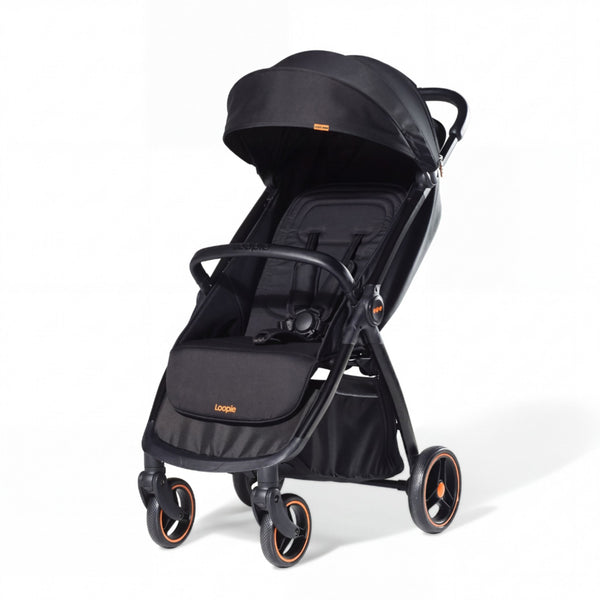
If you have a forward-facing stroller, the good news is you don't lose that connection entirely. Loopie Hop's mesh panel lets you keep an eye on your baby while they face forward, so you can still catch the moment they spot their first pigeon with absolute fascination, even if they're not looking directly at you.
And if your baby seems to love watching the world go by earlier than expected — as one parent on r/Buyingforbaby noted, "My baby HATES rear-facing anything. She loves watching the world from her front-facing stroller — it's what makes her happy." — listen to them. Every baby sets their own pace.
Factors Indian Parents Need to Keep in Mind
Most stroller guides are written for parents in London or Toronto. They don't account for Indian roads, Indian weather, or Indian home sizes. Here's what actually changes the equation here.
Roads are bumpy — speed breakers, potholes, uneven pavements. A stroller with quality suspension isn't a luxury; it's a necessity. This matters more for reversible strollers, which tend to be heavier and need a stable base.
Indian summers regularly hit 40°C and above in urban cities. A large, UV-protective canopy is non-negotiable. In a parent-facing position, your body also provides natural shade. In forward-facing, a good canopy does the work.
Houses with compact storage and older buildings with narrow lifts or no lift at all. A lighter, compactly folding stroller wins in that environment, even if it means choosing forward-facing earlier. A stroller that doesn't fit in your boot or can't be carried up three flights of stairs is a stroller you'll stop using.

Indian hatchbacks — the Swift, i20, WagonR have smaller boots than the SUVs that most Western stroller reviews assume. Always check the folded dimensions of any stroller against your car's boot space before buying.
Metro and bus travel in cities requires a stroller that's easy to fold one-handed (while holding your baby with the other), lightweight enough to manoeuvre through crowds, and compact enough to fit in a busy coach. Forward-facing strollers generally win here.
Joint families are a genuine advantage. When grandparents and relatives are involved in daily childcare, a parent-facing stroller gives everyone — not just parents — a natural way to connect, talk, and play. That language-rich interaction the research highlights doesn't require it to be the mother or father pushing the stroller.
Features to Look for when Buying a Stroller
For Indian conditions: look for a 5-point harness, a large UV-protective canopy, good suspension for uneven roads, and a compact one-hand fold if you use public transport. You can also explore our guide on How to Choose a Baby Stroller to learn more about stroller features.
While buying for a newborn, confirm the seat reclines fully, reversible or not. And always check whether the brand has service support in your city before you buy.

Common Mistakes to Avoid while Buying a Reversible
Buying reversible when your baby is already 10+ months. The parent-facing phase is largely done by then. You'd be paying a premium for a feature you'll barely use.
Assuming "reversible" means "safe from birth." It doesn't. Check the recline angle. A semi-reclined seat is not appropriate for a newborn.
Buying based on Western reviews. A stroller that's perfect for flat pavements in Amsterdam may struggle on the roads outside your society gate in Pune.
Ignoring fold dimensions. Measure your car boot. Then check the stroller's folded size. Then buy.
Skipping after-sales research. In India, getting a stroller serviced or replaced can be complicated for brands without a local presence. This matters more than people expect.
Decision Checklist: Which One Is Right for You?
Choose a reversible (parent-facing) stroller if:
-
Your baby is 0–9 months old.
-
You're buying before birth and want one stroller for the full journey.
-
Bonding, language development, and easy monitoring matter to you.
-
You have a sedan or SUV with a reasonable boot.
-
You're in a joint family with multiple caregivers involved.
Choose a forward-facing stroller if:
-
Your baby is 9 months or older.
-
You use the metro or bus transport regularly.
-
You live in a compact apartment or have no lift access.
-
You drive a hatchback with a small boot.
-
Budget is a real consideration (forward-facing options are generally more affordable).
-
Your baby is curious, active, and ready to face the world.

Our Approach While Building Loopie Hop
When we set out to build Loopie Hop, one of the earliest decisions we made was to go forward-facing, and it wasn't arbitrary.
A lot of reversible strollers are built to do everything, which often means they end up being heavier, bulkier, and harder to manoeuvre in the kind of spaces Indian parents actually navigate daily. We wanted to build something that was genuinely city-ready from the ground up — not a compromise between two configurations, but a stroller designed with one job in mind and done well.
There was also a practical reality we kept coming back to. Most babies transition to forward-facing around six months, when head and neck control develops and curiosity about the world kicks in. For many parents, this means either buying a second stroller at that stage or continuing with a reversible that's heavier than what they actually need. We wanted to skip that cycle entirely and give parents something built for exactly that stage, and everything that comes after it.
Forward-facing also allowed us to make specific choices around frame construction and weight distribution that a reversible design simply doesn't allow for. When you're not engineering a seat to rotate and lock in two directions, you can focus that effort elsewhere — on a stronger, sturdier frame, a more stable ride, and a fold mechanism that actually works one-handed when you're holding a baby with the other arm.
We thoughtfully designed a peekaboo window and other mesh panels to address one of the most common concerns parents raise about forward-facing strollers: "But how will I see my baby?" It lets you check on them without stopping, crouching, or breaking your stride. That visibility, we felt, wasn't something parents should have to give up just because their baby is facing the world.
Loopie Hop is built for the city: for metros, hatchback boots, narrow lifts, and Indian summers. Forward-facing wasn't a limitation we worked around. It was the starting point we built everything else from.
FAQ: Most Asked Questions on Forward & Rear-Facing Strollers
Q: Can a baby use a forward-facing stroller from birth?
No. Newborns need full recline and face-to-face contact. Parent-facing is essential from 0–6 months, and recommended through 9–12 months for most babies.
Q: When should I switch from parent-facing to forward-facing?
Most babies are ready between 9–12 months, when they can sit independently and show curiosity about their surroundings. Follow your baby's cues as much as the calendar.
Q: Does stroller direction really affect bonding and language development?
Research says yes. The National Literacy Trust-commissioned study found parents were twice as likely to talk to babies in face-to-face positions. That conversation is what builds language and attachment in those early months.
Q: Is parent-facing better for newborns?
For newborns specifically, yes — and for good developmental reasons. But this changes as your baby grows. By 9–12 months, most babies are ready and eager to face the world, and forward-facing supports exactly that next stage.
Q: What should Indian parents specifically look for in a stroller?
Good suspension for bumpy roads, a UV-protective canopy for Indian summers, compact fold for metros and hatchbacks, flat recline if buying for a newborn, and after-sales service in your city.
Q: Can I switch back and forth between parent-facing and forward-facing?
If you have a reversible stroller, absolutely — and many parents do. Facing forward on a busy park walk, facing you for the school run. Let the setting and your baby's mood guide you.
Happy Strolls to Your Li’l One
There's no single right answer here — and that's actually the reassuring part. A parent-facing stroller in the early months gives your baby connection, language, and calm. A forward-facing stroller gives them curiosity, independence, and a view of the world they're genuinely ready to explore.
The best stroller is one that fits your baby's stage, your city's roads, your home's layout, and your daily life. Everything else — brand names, features, price points — comes after that.
You already know your baby better than any guide does. Trust that, do the research, and make the call that works for your family.