Using a baby stroller safely is not complicated, but it does require consistent habits. Most stroller injuries happen not because of faulty products, but because of how strollers are used — a buckle skipped, a brake unlocked, a handle overloaded.
This guide covers the nine most critical stroller safety practices every parent should follow when using a baby stroller. We have also shared some of the common mistakes new parents make while using a baby stroller, and suggested some of the safest baby strollers in the Indian market as of 2026.

Top 9 Safety Tips for Using a Stroller
1. Always Use the 5-Point Harness
The 5-point harness system straps over both shoulders, both hips, and between the legs. It is non-negotiable for stroller safety. Babies are wiggly, and even if you’re only using the stroller for a short trip, they can easily slide or fall out.
So, always buckle your child snugly, making sure the straps are adjusted properly. The harness should pass the two-finger test: you should be able to slide exactly two fingers under the chest clip — no more, no less.

2. Keep Your Baby Buckled Even When Stationary
It’s tempting to think, “We’re not moving, so I don’t need to buckle my baby.” But even when stationary, babies can wiggle, shift, or lean over the sides. Always keep your child buckled in, whether you’re sitting at a park bench or waiting at the doctor’s office. It’s a small habit that greatly reduces risks.

3. Lock the Brakes Every Time You Stop
Even if you’re just stopping for a minute, whether to chat with a friend, tie your shoelace, or grab a coffee, always lock the stroller brakes. It may feel unnecessary in the moment, but if you make it a habit, it’s one thing less to worry about. It’s a quick action that keeps your little one safe in all situations.
Different strollers have different braking systems. If your stroller has one-touch linked brakes, use your foot to press down firmly until you hear a click. For separate wheel brakes, ensure both sides are engaged. Give the stroller a gentle nudge to confirm it doesn't roll before letting go.

4. Avoid Using Strollers on Stairs or Escalators
Pushing a stroller on stairs or escalators is a huge safety risk. You can lose balance, the stroller can tip, and you risk losing grip altogether.
Instead, use ramps and elevators; they’re designed for strollers and wheelchairs. If ramps aren’t available, fold the stroller and carry it in one hand while holding your baby in the other (or use a baby carrier).
If you're a new city parent looking to improve stroller maneuverability on sidewalks and in malls, check out our article on navigating the city with a stroller.

5. Never Leave Your Baby Unattended in the Stroller
Even if your baby is fast asleep, never leave them unattended in a stroller indoors or outdoors. Babies can wake up suddenly, lean forward, or grab onto unsafe objects. An unattended stroller may also be at risk of an unwanted accident.
If you need to step away, even for a second, take your baby with you. It’s inconvenient, yes, but essential for safety.

6. Watch Out for Sun, Heat, and Weather Conditions
Always be mindful of the weather conditions while taking the stroller outside. Use the stroller’s built-in canopy. On warmer days, strollers with ventilated openings can make your child feel a lot more comfortable. Similarly, always keep the stroller rain cover handy.
A 2012 study published in Pediatrics found that covering a stroller with a blanket can raise the internal temperature by up to 15°C within minutes, cutting oxygen flow significantly. Use the built-in canopy or a clip-on UV shield designed specifically for stroller use.

7. Don’t Overload the Stroller Handle
Attaching your diaper bag to the stroller handle is both practical and convenient. It keeps all the necessary items handy for quick access. However, it is important to follow the guidelines provided along with the diaper bag for safety. Most stroller manufacturers cap the handle-hook weight at 1–2 kg, even when the bag itself can hold far more.
Exceeding this shifts the stroller's centre of gravity backward, which is the leading cause of stroller tip-overs when a baby leans forward. Hence, always check the instructions and guidelines provided by the manufacturer for safe usage

8. Avoid Overloading the Storage Basket
Similarly, the under-seat basket is every parent’s best friend, but overloading it can make the stroller overly bulky.
-
Follow the weight limit in the stroller manual (usually 5 kg).
-
Spread the load evenly instead of piling everything on one side.
-
Avoid sharp or bulky items that may poke through.

9. Ensure Proper Footwear and Clothing for Stroller Rides
Loose clothing, oversized footwear, or dangling accessories can get caught in stroller wheels or moving parts. This is especially risky with active toddlers who kick their feet while riding.
Dress your baby in weather-appropriate, fitted clothing before stroller outings. Ensure shoes are securely fastened and not too loose. Tuck in any long straps from bags or blankets. Watch for drawstrings. Drawstrings on hoods or jacket hems are a specific entanglement risk near wheel spokes and folding joints. Opt for snap or velcro closures on baby outerwear during stroller rides.
During cooler months, use stroller footmuffs instead of loose blankets that can dangle. Before starting your walk, do a quick visual check to confirm nothing is hanging near the wheels.
10. Maintain and Inspect Your Stroller Regularly
As with any piece of baby gear, it is important to regularly check your baby stroller from both cleanliness and safety perspectives. You should check your stroller thoroughly once a week and every time before an upcoming long trip.
Here’s a quick checklist for stroller upkeep:
-
Test brakes every week to make sure they lock securely.
-
Inspect wheels for wobbling or wear and tear.
-
Check that the harness clips are not broken or frayed.
-
Clean the fabric regularly to prevent mould or bacteria buildup.
A quick 5-minute inspection can save you from unexpected stroller malfunctions. This guide explains simple stroller maintenance at home

How to Use a Stroller For a Newborn Specifically
Newborns under 6 months cannot hold their heads up independently, which changes how you use a stroller compared to older babies.
-
Keep the seat fully reclined (180°) until your baby has consistent head control, typically around 4–6 months.
-
Use a newborn insert or head support cushion to prevent the head from slumping sideways.
-
Limit continuous stroller time to 1–2 hours for newborns, as the semi-reclined position can affect breathing in very young infants.
-
Always check that the recline mechanism is locked before placing your baby inside.
Also read: When can a baby sit in a stroller?
5 Stroller Safety Features You Should Check Before Buying
Here are 5 important Safety features to look for before buying a stroller:
-
5-Point Harness: Secures the shoulders, waist, and legs of the baby. Prevents slipping out on bumpy rides.
-
Lockable Recline: Essential for newborns under 4–6 months; an unlocked or semi-reclined seat affects the airway.
-
Reliable Brakes: Foot-operated, lockable rear wheels for instant stops on slopes.
-
Wide Wheelbase: Boosts stability, reduces tipping on uneven Indian roads.
-
Sturdy Frame: Aluminum/steel build withstands daily use without wobbling.
This article on how to choose a baby stroller, highlights more underrated stroller features.
Top-Rated Safest Stroller Options in India
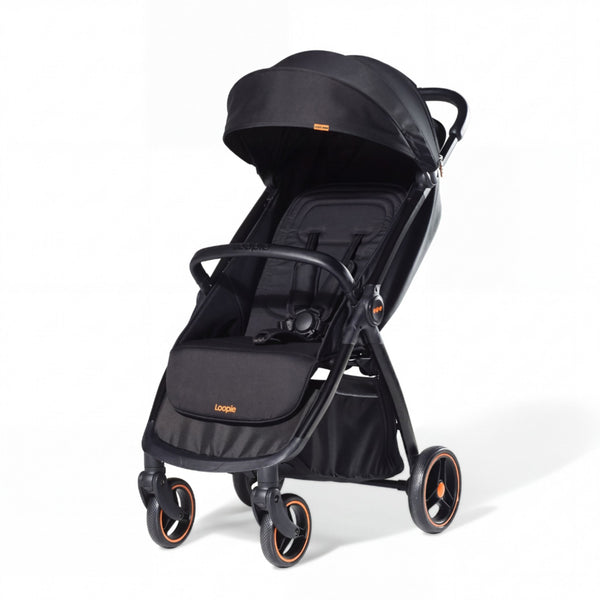
1. Loopie Hop
-
EN 1888-2: 2018+A1:2022 certified
-
5-point harness with magnetic buckle
-
Reflector lines for evening visibility
-
Wide wheelbase aluminum frame for anti-tip stability
-
Linked foot brakes tested for wet Indian surfaces
2. Stokke YOYO3
-
5-point harness meeting international safety standards
-
4-wheel Hytrel elastomer suspension for bumpy roads
-
Reflective wheels for low-light visibility
-
Auto-lock fold mechanism
-
Extended UV canopy with peek-a-boo window
3. Cybex Libelle
-
One-pull 5-point harness, adjustable single-handed
-
Front-wheel suspension for uneven surfaces
-
Auto-lock when folded
-
UPF 50+ canopy
-
Flame-retardant-free certified fabrics
4. R for Rabbit
-
EN 1888 certified
-
One-step linked brake system
-
5-point adjustable harness
-
Multi-position recline with India-specific suspension
-
Reversible parent-facing handle
All four carry EN 1888 certification, the European benchmark that tests strollers for structural integrity, harness strength, brake performance, and folding safety under repeated stress — a meaningful guarantee for Indian conditions like monsoon puddles, broken footpaths, and long travel days.
Each stroller also addresses a specific gap. The YOYO3 and Cybex Libelle have auto-lock folds that prevent accidental collapsing in transit. R for Rabbit's suspension is tuned for rough Indian roads, reducing jolting that affects both comfort and harness effectiveness. The Loopie Hop's magnetic buckle eliminates the most common harness mistake parents make — an incorrectly clicked clasp.
Common Stroller Safety Mistakes Indian Parents Make
These are the most frequent stroller misuse patterns, specific to Indian urban conditions:
-
Using the stroller on building ramps without checking the slope. Steep parking ramps in malls and apartments are not the same as gentle pedestrian ramps, and the stroller can accelerate suddenly.
-
Leaving the stroller in direct afternoon sun before use. Metal frame parts and dark seat fabric can reach 50°C+ in Indian summers. Always check the seat with your palm before placing your baby.
-
Rushing through the metro station gates while entering/exiting the station. The gap between the gate sensor and the closing barrier is a pinch point for stroller wheels. Activate the stroller-friendly gate at the station or ask station staff.
-
Using a stroller during peak pollution hours. In Delhi, Mumbai, and Bengaluru, AQI spikes between 7–10 AM and 6–9 PM. A baby's airway is significantly more vulnerable than an adult's. Time your outings around this.
You can read our guide on how to protect babies from poor AQI
Summing Up!
A stroller is your child’s safe space while you’re out exploring the world together. And while most strollers today are designed with excellent safety features, the real difference comes from how consistently parents use them.
From fastening harnesses properly and locking brakes at every stop to being mindful of weather, terrain, and storage habits, these small actions add up to big protection.

With Loopie Hop, safety and comfort were the top priority for us. From a 5-Point Harness with Magnetic Buckle to Reflector Lines for low light visibility, we focused a lot on safety features to make every journey with your little one smooth and comfortable.
Think of stroller safety as second nature, much like buckling a car seat. Once it becomes a habit, you won’t even have to remind yourself; your hands will automatically check the harness, your foot will instinctively press the brake, and your eyes will scan the path ahead.
At the end of the day, safety is not about restricting fun; it’s about giving you peace of mind so you can truly enjoy these everyday adventures.
Frequently Asked Questions (FAQs)
What are the safety requirements for a stroller?
Strollers must meet BIS/IS 14675 standards in India: 5-point harness, dual brakes, weight capacity labelling, no pinch points, flame-retardant fabrics. JPMA is certified globally.
Can I use a baby stroller from birth?
Yes, but only if the stroller has a fully flat ~180° recline or a compatible carrycot attachment. Newborns under 4 months cannot support their head independently, so a semi-reclined seat poses a breathing risk. Always use a newborn head insert and check that the recline lock engages fully before placing your baby inside.
How can I keep my baby entertained during stroller rides?
Attach a stroller toy bar at eye level for babies under 6 months — high-contrast patterns and soft rattles hold attention without overstimulating. For older babies, the forward-facing position itself provides enough visual stimulation. Talking to your baby during the ride, narrating what you both see, supports language development and keeps them engaged far better than any accessory.
What stroller features prevent accidents on uneven monsoon roads?
Four features matter most on wet, uneven Indian surfaces. First, a wide wheelbase lowers the centre of gravity and resists tipping on broken footpaths. Second, all-terrain suspension absorbs sudden jolts that can destabilize a stroller mid-push. Third, linked foot brakes that engage both rear wheels simultaneously prevent rolling on wet slopes where a single-wheel brake loses grip quickly. Fourth, rubber or foam-filled tyres maintain traction on wet surfaces better than hard plastic wheels, which skid easily in the rain.
How to stop stroller tipping?
Distribute weight evenly; avoid steep hills; use models with wide bases like Loopie Hop; never hang bags on the handlebars.
How to maintain stroller safety over time?
Inspect weekly for loose parts; lubricate joints; clean regularly; replace worn harnesses; follow manufacturer recalls.
Can I use a stroller on stairs or escalators?
Never use a stroller on stairs or escalators. Carry folded or use elevators. Stairs risk tipping; escalators can trap wheels/hands. Carry the baby separately.