A car seat belt is built for an adult body, not a child's. When a child sits directly on it, the lap belt often rests across the soft belly rather than the hip bones, and the shoulder belt can cut across the neck rather than the chest. A booster seat fixes both, lifting a child just enough so the belt works the way it was designed to.
This read is for parents of children roughly 4 to 12 years old who have outgrown a forward-facing harness seat, families currently relying on an adult seat belt alone, and anyone weighing whether a short, familiar drive really needs a booster.
Here is what actually makes a booster seat work, how to tell if your child still needs one, and what to look for when choosing the right fit for your family.

What to Keep in Mind
This is general safety information, not medical or professional advice. Loopie is a baby gear brand, not a regulatory or medical authority, so always follow your vehicle manufacturer's guidance and the booster seat's own instructions on age, weight, and height limits.
On the legal side, Indian motor vehicle rules require age- and height-appropriate restraint for young children travelling by car. Some states have gone further with explicit guidance: Kerala's Motor Vehicles Department, reported by Kerala Kaumudi, specifies that children above 4 and up to 14 years, and under 135 cm in height, should be seated on a child booster cushion with the seat belt buckled, in the rear seat only. The same report makes an important point: age is only a rough guide, and how well a child actually fits the seat belt matters more.
Certified Child Passenger Safety Technician checks, common in some countries, are not yet a widespread, formal service across India. A few hospitals and road safety organisations run occasional awareness sessions on child seat fitment, but there is no regular nationwide network to rely on. If one is available in your city, it is worth using. Otherwise, the vehicle and booster manuals remain the most reliable guide.
What a Booster Seat Actually is
A booster seat is a belt-positioning device, not a seat in the way an infant car seat is. Its entire job is to raise a child so the existing adult seat belt lands in the right place: the lap belt low across the hip bones, the shoulder belt across the middle of the chest and shoulder, not the neck.
Think of it as a belt trainer. It does not restrain the child on its own. It simply makes sure the car's seat belt, which was engineered for adult proportions, fits a smaller body correctly. NHTSA's guide to car seats and booster seats frames this clearly: booster seats work by positioning the belt over a child's stronger bones instead of soft tissue.
Smruti G Munavalli, Product Designer at Loopie, put it: "A booster isn't about restricting a child's movement; it's about ensuring that the car's existing safety systems work as intended."
Does Your Child Still Need a Booster? Run the 5-Step Test
Rather than going by age alone, run this quick check every time your child gets in the car:
-
Does the child sit all the way back against the seat?
-
Do their knees bend comfortably at the edge of the seat?
-
Does the shoulder belt sit between the neck and the arm, not across either?
-
Does the lap belt rest low across the hips, not the belly?
-
Can they hold this position for the entire drive, not just the first five minutes?
If the answer to any of these is no, the booster stays. Most children need it until somewhere between 10 and 12 years old, but plenty of eight and nine-year-olds still fail this test, especially in smaller cars.
Interested in learning more about every car seat group, the weight and age range each one applies to, when to move your child to the next group, and how to choose a seat that keeps working as your baby grows? Read our blog: Child Car Seat Groups Explained for Indian Parents.

Here is the most interesting part: the same child can pass this test in one car and fail it in another. Seat-back height, cushion depth, and where the belt anchors sit all vary by vehicle.
As Smruti explains, "During development, the booster is evaluated across multiple vehicle types to ensure that the vehicle's seat belt routes correctly over the child's shoulder and lap, regardless of differences in belt anchor points or seat geometry." She's candid that no single design guarantees a perfect fit everywhere: "There isn't a single design solution that guarantees a perfect fit in every vehicle, as car seats, belt anchor positions, and interior geometries vary significantly across manufacturers and models."
What helps, in her experience, is a booster built with adjustable headrests, well-placed belt guides, and a stable base that adapts across different seats, tested across a range of vehicles rather than one.
That is worth remembering the next time a booster fits perfectly in your car but feels a little off in a relative's.
Is a Booster Seat Actually Worth It?
Parents in India often drive short, familiar distances, a quick school run or a ten-minute hop to the market, and it is easy to assume this counts as low risk. Crash physics does not really recognise the difference between a short trip and a long one. Sudden braking, a scooter cutting across a junction, or another vehicle misjudging a turn can happen on any stretch of road, however well known.
Research compiled by CarSeat.org found that children using adult seat belts without a booster face close to twice the risk of severe internal and spinal injuries compared with children properly seated in a booster. Without the correct positioning, a belt can load the soft abdomen, raising the risk of injury to the liver, spleen, or intestines, or ride up against the neck instead of the shoulder.
India-specific crash data on boosters specifically is still limited. What is well documented is that overall rear seat belt use among children remains low, and that road crash risk for young passengers in India is high. SaveLIFE Foundation's study on rear seat belt usage and child road safety in India points to exactly this gap between how often children are properly restrained and how often they should be. A booster seat, used correctly, closes part of that gap directly.
There is also an everyday benefit. A belt sitting in the wrong place is uncomfortable, and discomfort is often why children fidget with it, slide it behind their back, or try to loosen it mid-drive. Research published in the journal Sport in Society via Taylor & Francis Online notes that comfort plays a real role in whether children stay correctly seated. A well-fitted booster is not just safer. It is also easier to actually get children to use.

How Indian Heat, Dust, and Daily Use Factor Into Materials
A booster seat spends most of its life inside a parked car, and Indian summers are not gentle on plastic or foam. According to Smruti, the shell is typically built from high-impact polypropylene, chosen because it "absorbs and distributes crash forces without becoming brittle" and stays structurally stable "across the range of temperatures typically experienced inside parked vehicles."
For cushioning, many boosters use Expanded Polypropylene foam rather than the single-use foam found in helmets, because it "recovers its shape after minor impacts instead of permanently compressing" and holds up over years of daily use, sometimes layered with a softer polyurethane comfort foam for everyday comfort.
Designing specifically for Indian conditions means going a step further. As Smruti describes it, "vehicle interiors can become extremely hot, sunlight is more intense, and dust is a part of everyday use," which is why boosters built for this market use heat-resistant, UV-stabilised materials, along with breathable, removable covers that are easy to clean and quick to dry.
Even well-built materials have a shelf life. Smruti notes that a shell and foam are typically designed to hold their protective performance for around seven to ten years under normal use, provided the seat has never been in a crash. Cracks, warping, fading, or a foam that feels crumbling or compressed are all signs it is time to retire the booster, regardless of how it looks from a distance.
The Benefits of Booster Go beyond the Crash Itself
Correct belt positioning is the headline reason for a booster, but it is not the only one. Reduced risk of the belt riding up (sometimes called submarining), better posture through the drive, and added side protection on high-back models all add up over time.
There is a behavioural upside too. A genuinely comfortable child is less likely to spend the drive fighting with the belt. As Smruti puts it, "A sleek, modern appearance that feels more like a 'big kid' seat can reduce resistance," and supportive side contours can help a child sit upright without being told to, again and again.
For parents, the practical payoff is fewer mid-drive corrections, fewer arguments about the belt "hurting," and one less thing to think about when the child rides in a different car altogether.
Do you want to understand everything about baby car seat safety, including certifications, usage tips, and common mistakes to avoid? Read our blog here: Ensuring Maximum Baby Car Seat Safety.
How to Choose the Right Booster for Your Family
There is no single best type, only the right fit for your car and your child's age.
-
High-back boosters work well for cars with low seat backs or minimal head support, and they add side-impact protection along with built-in belt guides. Smruti notes they also help support a sleeping child's head and upper body, something backless boosters cannot do.
-
No-back boosters are lighter, more portable, and easier to move between cars, which suits older children in vehicles with good headrests already in place. The trade-off, as Smruti explains, is that they rely fully on the car's own headrest for support.
-
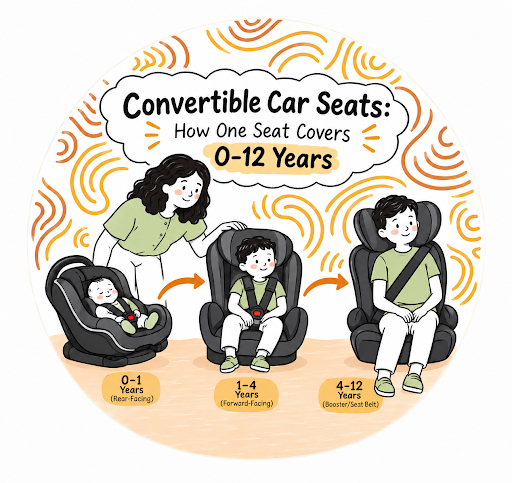
Harness-convertible boosters start as a forward-facing harness seat and convert into a booster later, which means a more complex build, since it has to manage two very different modes of crash protection, but it also means one seat can serve a child for several years.
On the question of price, it can be tempting to go with a cost-friendly option available. Smruti's honest take: cheaper boosters can still meet minimum safety requirements, but the difference usually shows up in less durable materials, reduced adjustability, and a shorter working life under heat and daily wear. A well-built booster is less an expense and more something that effectively does its job for years without needing a second thought.
Note: Wherever possible, place the booster in the rear seat, and always with a lap-and-shoulder belt. A booster should never be paired with a lap-only belt.

When the Car Changes, Check the Fit
Many Indian families do not use just one car. A grandparent's car for the school run, a relative's car during a family trip, a rental during festival travel home- each one brings a different seat shape and belt geometry into the picture.
This is exactly why fit deserves a second look every time the booster moves to a new vehicle, even briefly. Run the 5-Step Test again. It takes less than a minute and tells you everything you need to know.
Festival season and long holiday drives are often the moments parents actually pause to think about child safety in the car, more than the daily commute does. It is worth carrying that same attention into ordinary weeks too, since most drives happen there, not on the highway.
Conversations with grandparents or relatives who grew up without boosters can be gentle rather than a confrontation. Framing it around how seat belts themselves have changed, rather than suggesting anyone did anything wrong, usually lands better than a forced conversation.
A Few Things Worth Remembering
A booster only works if a child sits in it properly, so it is not a substitute for good habits during the drive. Fit is specific to each car, so what worked perfectly last month in one vehicle is worth rechecking in another. And age is only ever a rough guide. If your eight or nine-year-old still fails the 5-Step Test, there is no rush to move them out of the booster early.
FAQs: Parents’ Most Asked Questions About Booster Seats
Do kids really need booster seats?
Yes, once they outgrow a harness seat. Adult belts are built for adult bodies, and a booster repositions the belt so it protects a child's hips and shoulders instead of the belly and neck.
What age should a child start using a booster seat?
Usually between 4 and 6 years, once they outgrow a forward-facing harness seat and can no longer pass the 5-Step Test in a harness alone.
How long should a child use a booster seat?
Often until 10 to 12 years, but this depends on size, not age alone. Run the 5-Step Test regularly rather than going by birthdays.
Is a booster seat necessary for short drives?
Yes. Crashes are not less likely on short, familiar roads. A booster protects a child on every trip the belt is used, regardless of distance.
High-back or backless booster, which is better?
High-back boosters add side-impact protection and work well in cars with low seat backs. Backless boosters are lighter and easier to move between vehicles, relying on the car's own headrest for support.
My child says the booster is embarrassing. What can help?
Comfortable, modern-looking boosters tend to face less resistance. Letting the child pick the colour or design can also make a real difference.
Can a booster seat be used with just a lap belt?
No. Boosters are designed to work with a lap-and-shoulder belt together. A lap-only belt does not offer the same protection.
For a Safe & Protected Future!
A booster seat does something almost invisible: it puts the seat belt exactly where a child's body needs it, hips instead of belly, shoulder instead of neck. That one small shift is what turns an adult seat belt into real protection for a smaller passenger.
None of this depends on how far the drive is, how new the car feels, or how grown-up a child seems. It depends on whether the belt actually sits where it should, every single time. The 5-Step Test takes less than a minute and answers that question honestly. A booster built for Indian heat and daily wear holds up for years. And a fit that works perfectly in one car is always worth rechecking in another.
Whichever car your family drives, however familiar the route, that small adjustment is worth carrying with you, on the school run, the festival trip home, and every ordinary drive in between.