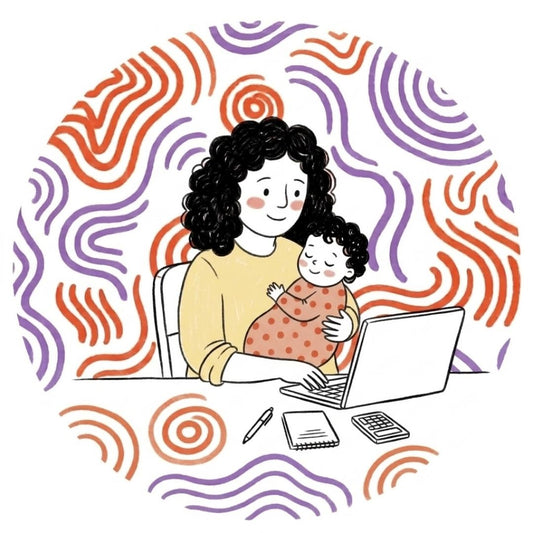
A lot of women worry that having a child means giving up on ambition. This blog looks at what actually changes for a woman's ambition after motherhood, and what doesn't, through decisions around childbirth, mom guilt, and sharing parenting with a partner.
Sifat Khurana, co-founder of Innovist, the company behind Bare Anatomy, Chemist at Play, and SunScoop, spoke about this with Akriti Gupta, founder of Loopie, on a recent podcast episode of The Parent Code, from choosing a C-section under pressure to figuring out how much of the parenting load her husband could take on. Further on, you’ll learn how to make tough decisions without second-guessing yourself, sit with mom guilt instead of pushing it away, and loosen your grip on control without lowering your standards.

What to Keep in Mind
This read draws from Sifat Khurana's personal experience and publicly available research, not from a medical or legal professional. Every mother's circumstances are different, and decisions around childbirth, feeding, or returning to work deserve a conversation with your own doctor or counsellor. What follows is meant to widen the options you feel you have, not narrow them.

Ambition Doesn't Wait for the Right Time
Long before Innovist, Sifat Khurana was the first employee at The Man Company, working two hours away from home for a founder she barely knew, on a pay cut, for a brand nobody had heard of yet. She stayed for two and a half years, then walked out with her co-founder Rohit the day the company was acquired, unsure of what came next.
That uncertainty is where Innovist began. Along with Rohit and co-founder Vimal, Sifat built a business around a very specific frustration: personal care products that are marketed at everyone but rarely work for any one person. Bare Anatomy's personalised hair care model came out of that idea directly.

Ten years in, she describes the three co-founders as running on separate, respected lanes. Vimal handles research and manufacturing, Rohit handles strategy and finance, and creative and brand experience are entirely hers. They argue, often over small things like a catalogue photo, but they've learned exactly when to push and when to let it go.
It's a reminder that most partnerships don't work because everyone thinks alike. They work because everyone knows their lane and trusts the others to hold theirs. If you're building anything with other people, that division of ownership matters more than finding someone who agrees with you.

Planning Motherhood Alongside a Business
Sifat didn't plan her pregnancy around a spreadsheet. She and her husband moved cities twice, first from Bangalore, then from Chandigarh to Gurgaon, largely to be closer to her team as Innovist grew. Somewhere in that relocation, the idea of having a child stopped feeling like a distant plan and started feeling possible.
Akriti shares a similarly unplanned-feeling moment from her own path into motherhood, signing Loopie's term sheet on the day she delivered her baby, a detail that captures something both women return to throughout the conversation: work and motherhood rarely arrive as separate chapters. They tend to unfold alongside each other.

It helps to know Sifat isn't an outlier in facing that tension. Ashoka University's Genpact Centre for Women's Leadership, in its "Predicament of Returning Mothers" report, found that 73% of Indian women leave their jobs after giving birth, and even among those who do return, 48% drop out again within four months.
Whatever your own timeline looks like, this is part of why waiting for a version of "ready" with no loose ends rarely works out. The clarity people look for tends to show up after they've already started moving, not before it.

C-Section or Natural Birth: Why the 'Right' Choice Isn't Universal
At 37 weeks, a routine scan showed the cord wrapped around her baby's neck. Her doctor told her induced labour could still lead to a C-section anyway, and asked her to wait for a longer stress test before deciding anything. Sifat asked a different question instead: what's the actual probability of ending up in surgery regardless?
When the answer came back at 70%, she didn't hesitate. She asked to be taken in for the C-section directly, even though she'd spent her whole pregnancy hoping for a natural birth. Her doctor pushed back, reminding her what she'd said for nine months. Sifat's response was simple: she'd thought about it enough, and she wasn't willing to put her body through labour for a 30% chance that might still end the same way.

She's since become fairly direct about rejecting the idea that one kind of birth is more admirable than another. That instinct lines up with where India's data has been heading. Government figures reported via Medical Dialogues show C-sections now account for over 27% of all reported deliveries nationally, a number that varies hugely between public hospitals (closer to 17%) and private ones (often well above 50%).
Her approach offers a useful template for any high-stakes call: ask for the actual numbers, not reassurance, and let those numbers guide the decision rather than what you'd originally hoped for. Whatever your birth plan looks like, the C-section-versus-natural debate says more about outside judgment than it does about which choice is right for you.

The Postpartum Identity Crisis No One Prepares You For
Sifat went back to work within days of her delivery, not because anyone at home or at the office expected it, but because staying away from work for even a single day left her feeling unmoored. She's candid about calling it an identity crisis: loving her son completely, and still feeling like she was losing a piece of herself by not working.
Her reframe is the part worth sitting with. Loving your child and loving your work aren't two loyalties competing for the same hours. Trying to force yourself into only one of them, she found, is what actually makes the whole thing harder to carry.

If you've gone back to work sooner than people expected and felt strange about it, that discomfort usually says more about unspoken ideas of what a "good" mother does than about any decision you actually got wrong. If this stage feels uncharted, it's worth reading how other Indian mothers have approached that same re-entry; you can read more about joining work after a baby.
Why Support Systems Matter: Redesigning the Village
None of this worked because Sifat did it alone. Her mother-in-law handles the day-to-day questions without calling her at the office. Her husband took extended paternity leave and later shifted to half-days so one parent was always available. For a while, they alternated days entirely, and sometimes brought the baby to work with a nanny in tow.

Letting go of control took practice. It took Sifat fifteen days to stop supervising her nanny during bath time before she could finally trust her fully. She's equally clear-eyed about partners: when she heard a friend's husband ask how to stop his wife from burning out, her advice was direct.
The load only shifts when the partner proves he can carry it, not when the mother is asked to trust more. Loopie's earlier read on how fatherhood is evolving in India covers this same shift from a father's side of the table.

This kind of support isn't a nice-to-have. A systematic review published in the Bulletin of the World Health Organization found that postpartum depression affects roughly 22% of Indian mothers, with low social support consistently among the strongest risk factors.
The takeaway isn't that you need a live-in mother-in-law or a partner who can shift to half-days. It's that whatever support you do have- hired help, a parent, a friend- is worth using fully instead of half-trusting. Guilt about outsourcing childcare usually costs more than the outsourcing itself.

Feeding Choices, Mom Guilt, and Giving Yourself Permission
Sifat exclusively breastfed her son and describes those sessions as the most uninterrupted, connected time she had with him each day. She's just as quick to say formula was never the lesser choice in her mind, only a different one.
What stayed with her most was a small moment in a mothers' WhatsApp group: a woman asking if it was "okay" to pump milk at night so her husband could handle a feed. That question, more than any parenting debate, showed her how much permission mothers feel they need to ask for, for choices that were always theirs to make.

Her own guilt broke open mid-meeting, watching a video her husband sent of their son laughing at home. She realised the guilt wasn't protecting her son from anything. It was only taking something from her.
If you've ever caught yourself asking someone's permission for a decision that was always yours, that's worth noticing. Whether it's pumping milk, switching to formula, or handing your baby to your partner for the night feed, the choice doesn't need outside approval to be the right one.
FAQs: Common Questions New Parents Ask
Is it okay to go back to work soon after having a baby?
There's no universal timeline. What matters more than the number of days is whether your body has recovered enough and whether you have the right support in place. If staying connected to work helps you feel like yourself, that's a valid reason to return early, not something to feel guilty about.
Is formula feeding worse than breastfeeding?
Exclusive breastfeeding for the first six months is the standard medical recommendation, but formula is a safe, valid choice when breastfeeding isn't possible or isn't preferred. Neither choice says anything about how good a parent you are.
Does becoming a parent make you less ambitious?
Not necessarily. Ambition usually stays intact after having a child; what tends to shift is the path to it: slower in some seasons, faster in others, shaped by new priorities rather than reduced drive.
How can partners share the parenting load more fairly?
Start with specific, repeatable tasks, one feed, one bath, one bedtime, rather than vague offers to "help." Trust in a partner's caregiving usually builds once they've actually done the task well a few times, not just been asked to.
The Real Measure of Motherhood
Asked how she'd want her son to describe her ten years from now, Sifat didn't take long to answer: available. Not perfect, not endlessly present, just reachable whenever he needed her.
That's her definition of doing the job well: being the person he calls first, happy or upset. It's a quieter standard than most checklists mothers are handed, and one almost anyone can meet, whatever your work hours look like on a given day. Being available doesn't mean being constantly present. It means being reachable when it counts, and that's something worth carrying with you long after this conversation ends.
Building for real, moving lives, not an idealised version of them, is a value Loopie holds close too.