A buggy is light, compact, and built for convenience. A stroller is sturdier, more supportive, and designed for everyday use. Both carry your baby – but they're built for different stages, different terrains, and different routines. Knowing which one fits your life makes the choice a lot simpler.
You're probably standing in a baby store, or more likely, scrolling through one at midnight — staring at words like buggy, stroller, pram, pushchair. The terminology genuinely overlaps, varies by region, and gets used inconsistently even by manufacturers. But the difference is real, and this guide breaks it all down with the Indian parents' daily life in mind.

Before You Decide: What to Keep in Mind
Every family's situation is a little different. But there are a few things worth thinking about before you land on a buggy or stroller:
-
Your baby's age and stage. A newborn has very different needs from a six-month-old or a toddler. The seat position, recline, and support all matter differently at each stage.
-
Where you'll actually use it. Daily park walks, mall trips, uneven roads, flights — these all call for slightly different things.
-
How much space do you have? Indian homes, car boots, and building lifts are often on the compact side. Fold size and weight matter more here than in other contexts.
-
Whether you need newborn compatibility. If you want to use it from birth, you need either a carrycot attachment or a seat that reclines fully flat. A standard buggy often doesn't offer this — more on that below.
-
Safety basics. A five-point harness, reliable brakes, a stable base, and safe folding mechanisms aren't optional extras. They're the baseline. (HealthyChildren.org, American Academy of Paediatrics)
Think of these as your filter, not a checklist to stress over. You don't need to tick every box; you need to know which boxes matter most for your life.

So, what exactly is a Buggy?
"Buggy" is one of those terms that means slightly different things depending on who you ask. In everyday parent conversation, and across most online forums, it's used as a catch-all term for anything with wheels that carries a baby. Many parents across discussion forums use "buggy," "pram," and "stroller" interchangeably without realising they describe different things.
Technically, a buggy refers to a lightweight, compact, fold-flat baby carrier — closer in nature to a stroller than a pram. Venicci describes it as most commonly used to refer to strollers and pushchairs, rather than a distinct product category of its own.
In practice, when people say "buggy," they usually mean one of the following things:
-
It is light and easy to carry.
-
Folds quickly and compactly.
-
It is designed for babies who can already sit with some support.
-
Works well for travel, errands, and short outings.
-
It is not necessarily designed for newborn use from day one.

Can a Newborn Use a Buggy?
This is one of the most common questions parents ask — and the answer is: it depends on the specific model, but generally, a standard buggy isn't the safest choice for a newborn.
Newborns need to lie flat. Their spine, neck, and head aren't developed enough to handle a seated or semi-reclined position for extended periods. Pampers India notes that a flat sleeping surface is crucial for infants in the early months, supporting restful sleep and spinal health. A buggy that doesn't recline to a fully flat position simply isn't built for that stage.
Some buggies do come with a near-flat recline or an infant insert — in those cases, always check the manufacturer's minimum age and weight guidelines before use.
What is a Stroller?
A stroller sits between a heavy-duty pram and an ultra-compact buggy. It's designed to be practical for everyday use — sturdy enough for regular outings, but still manageable to fold, carry, and fit into a car boot or a building lift.
Venicci describes strollers as lightweight daily models suited for babies from around six months, once they can sit with support. A good stroller for Indian roads and city use typically offers:
-
A seat that reclines to varying degrees (some to fully flat).
-
Wheels that can handle mild terrain, not just smooth, small floors.
-
A manageable fold for cars and storage.
-
Basic weather protection through a canopy.
-
A safety harness, preferably five-point.
For daily walks, school runs, market trips, and regular city outings, a stroller tends to be the most practical long-term choice for most Indian families.

Buggy vs Stroller: The Real Differences
Here's where it gets useful. Rather than going purely by labels, think about what each type is actually built to do.
|
Feature |
Buggy |
Stroller |
|
Age suitability |
Typically 6 months+ (check model) |
6 months+; some from birth with full recline |
|
Newborn use |
Generally not recommended unless it reclines flat |
Possible if the seat fully reclines or a carrycot is included |
|
Weight |
Lighter — easier to carry on flights and in cabs |
Moderate — still manageable for daily use |
|
Fold size |
Very compact — fits in overhead bins |
Compact but slightly larger |
|
Terrain handling |
Best on smooth surfaces |
Better on mixed terrain, including uneven roads |
|
Seat recline |
Limited in most models |
More recline options, including near-flat in some |
|
Durability |
Designed for lighter, occasional use |
Built for daily, regular use |
|
Storage basket |
Usually smaller |
Generally more storage |
|
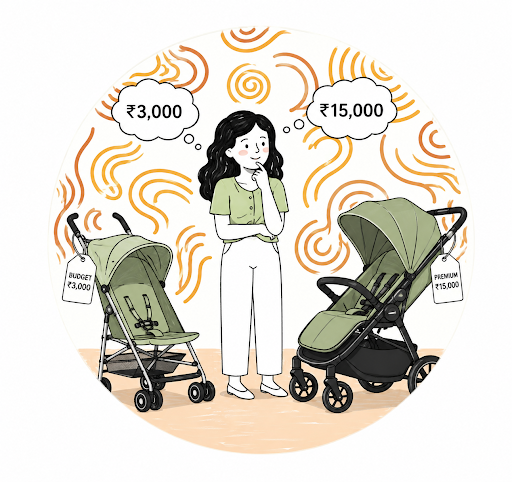
Price range |
Often more affordable |
Range from budget to premium |
|
Lifespan |
Shorter — often toddler stage only |
Longer — from infant to toddler |
Newborn comfort in a stroller vs buggy comes down to one thing: can the seat go fully flat? If not, it's not ready for a newborn.
Which One Actually Fits Your Routine?
This is the question that matters most. The "right" answer isn't the same for everyone; it's the one that matches how your family actually lives.
If you have a newborn
Go for a stroller with a full recline or a carrycot attachment, or a pram for the first few months. Do not compromise on the flat position at this stage. A buggy, however light and convenient, isn't the right fit yet.
If you're navigating Indian roads and uneven surfaces
A stroller with slightly larger wheels and a more stable base will serve you better. Many parents across Indian parenting communities mention that ultra-compact buggies struggle on broken pavements, speed bumps, and the mild off-road that comes with everyday city life. A stroller built for mixed terrain handles this more comfortably.
If you travel frequently — flights, cabs, trains
A lightweight buggy for travel wins here. It folds smaller, fits in overhead compartments, and moves through airports and stations without a fight. If you're looking for the best buggy for travel in India, prioritise fold size, weight, and cabin approval.

If you live in a compact home or use a small car
Both can work, but fold dimensions matter. Measure your car boot and lift dimensions before buying — this is a step many parents skip and later regret.
If you want one stroller for daily walks and longer outings
A stroller is a better long-term investment. It's built for more regular use, handles more varied terrain, and usually has better storage for those longer family outings.
If you need it only occasionally
A buggy might be a good option. It's lighter, easier to store, and more travel-ready — without the bulk of a full stroller you'd rarely use.
Think about how you actually live, not how you imagine you might. That's the most honest filter you have when choosing between a buggy and a stroller.
If you're interested in reading about the difference between a pram and a stroller. Check our guide here.
Why Should You Switch From Buggy to Stroller?
A buggy works well for travel and short outings — but as your baby grows, their needs change. Buggies are generally lighter and more compact, but they often compromise on recline depth, seat support, and terrain handling. A stroller is built for more regular, longer use — and that starts to matter more as your baby becomes part of your daily routine rather than just an occasional outing.
Pampers India suggests around six months as a general guide — once your baby has better head and neck control and can sit with some support. But every baby develops at their own pace. A more reliable signal than age alone is watching for your baby's ability to hold their head steady and sit with minimal assistance.
If your baby isn't quite there at six months, there's no rush. The transition should follow your baby's readiness, not a calendar.
One practical note: if you'd prefer not to buy two products across two stages, a convertible stroller that works from birth through toddlerhood can make the whole journey seamless — and save you from making the decision twice.
Stroller and Buggy Options Worth Considering
Buggy Picks
Chicco Goody XPlus: A great pick for parents who are always on the move. It folds at the touch of a button, takes up minimal space, and feels premium without being heavy. Parents note the smooth wheel manoeuvring as a standout. The one thing it's missing is a reversible handle — but for travel convenience, it's hard to beat.
gb Pockit+ All-Terrain: If fold size is your top priority, this one delivers. It's light, compact enough to fit under an airline seat, and genuinely easy to carry through airports and stations. Parents do flag that the build feels lighter than expected, so it's best treated as a travel and occasional-use companion rather than an everyday workhorse.
StarAndDaisy Convertible Pram: A solid value-for-money option for parents who want flexibility. The reversible handle, decent wheel quality, and good fabric are highlights. The folding mechanism could be smoother, but at this price point, it's a strong contender for everyday use.

Stroller Picks
Loopie Hop Stroller: Built for daily Indian city use — from birth to four years. Parents rate it highly for the ventilated seat, one-hand fold, and storage basket. At 8.4 kg it's not the lightest, but for everyday outings it strikes a good balance between comfort, safety, and practicality.
Graco Modes Pramette Travel System: A travel-system style option for families who want newborn-to-toddler flexibility in one setup. Easy to assemble, lightweight, and with generous underseat storage. Worth it if you want the convenience of a detachable car seat system.
Nuna TRVL LX: A premium lightweight option that folds quickly and includes a bassinet recline — useful if you want one stroller that handles both travel and early-stage newborn use. It's not the sturdiest frame on the market, but parents who prioritise ease and portability rate it highly.
For a more detailed guide, read our blog on the Best Baby Strollers in India (2026)
What Makes Loopie Hop Stand Apart From Buggies
Buggies are built for convenience — light, compact, easy to carry. But that convenience comes with trade-offs. Most buggies aren't designed for newborns, struggle on uneven terrain, and are built for occasional rather than daily use.
The Loopie Hop sits in a different category — and for Indian city life specifically, those differences matter.
It works from birth. The seat reclines fully flat, so you're not buying a pram for the early months and a stroller later—one product, from newborn to four years.
It handles Indian roads. The 8-inch rear EVA wheels and powder-coated aluminium frame absorb mixed terrain without rattling your baby around — something most compact buggies aren't built to do.
It breathes. The 360° ventilated Oxford cotton seat is a genuine advantage in Indian summers. Breathable fabric isn't a luxury when you're out for an hour in May heat.
It fits your life. Folded down to 57.5 x 48.5 x 29 cm, it fits in most car boots and building lifts without a reorganisation. The underseat basket carries up to 5 kg; enough for a full outing.
It's honest about its weight. At 8.4 kg, it's not the lightest option if you carry it up stairs daily. But for lift-accessible buildings and regular city outings, parents consistently rate it as worth it.
Certified to EN 1888 international safety standards. Designed in India and London, built for the roads most Indian parents actually use.

FAQ Questions Parents Have Around Safety & Function
Is a buggy enough, or do I need a stroller?
A buggy works well for travel and short outings. But as your baby grows and outings become more regular, a stroller's better support, recline, and terrain handling start to matter more.
When is the right time to switch?
Around six months is the general guidance — once your baby can hold their head steady and sit with some support. Every baby develops differently, so follow their readiness rather than the calendar.
Which is better for Indian roads — a buggy or a stroller?
For mixed terrain, uneven pavements, and typical Indian city conditions, a stroller with a stable base and slightly larger wheels tends to perform better. Ultra-compact buggies can struggle on rougher surfaces. If you're using it primarily for travel and smooth indoor spaces, a buggy works well.
Will my baby stay securely strapped in the buggy or stroller?
Look for a five-point harness — straps over both shoulders, both hips, and between the legs. Always use it, even for short outings.
What if the stroller or buggy rolls away on a slope?
Test the brakes before you buy. A brake that locks both wheels is safer than one that locks only one, and get into the habit of using it every time you stop.
Could the buggy or stroller tip over with my baby in it?
A wide, stable base is your safeguard here — especially on the uneven surfaces that come with everyday use in Indian cities.
Is folding the buggy or stroller going to be a hazard for my baby?
Keep your baby at a safe distance when opening or closing. Fingers can catch in hinges — it's one of the most commonly overlooked risks.
Can I hang my bag on the buggy or stroller handle?
It's tempting, but a heavy bag on the handle can tip it backwards. Use the storage basket instead, placed low and near the rear wheels. It's why the Loopie Hop's underseat basket is built to carry up to 5 kg — so that your baby’s stroller stays safe and stable.
At what age can a baby use a stroller?
Generally, from around six months, a baby can sit with some support and has reasonable head and neck control. Some strollers with a full recline can be used from birth — always check the product's age and weight guidelines.
Which is better for travel — a buggy or a stroller?
For air travel specifically, a lightweight buggy wins on fold size and portability. For overall family travel that includes varied terrain, a compact stroller may offer more comfort and versatility. It really depends on how and where you travel most.
Hop On And Unwind for New Adventures!
The difference between a buggy and a stroller isn't about which one sounds better or looks more premium. It's about which one fits your baby's current stage, your daily routine, and the very specific reality of getting around in an Indian city.
If your baby is a newborn, flat recline comes first — everything else is secondary. If you're a parent who travels often, fold size and weight matter most. If you're looking for something for daily use across the next few years, durability and terrain handling deserve more attention.
There's no single right answer here. But there is a right answer for your family. Take the checklist seriously, match the choice to your actual life, and trust that you'll figure out the rest as you go. Most parents do.