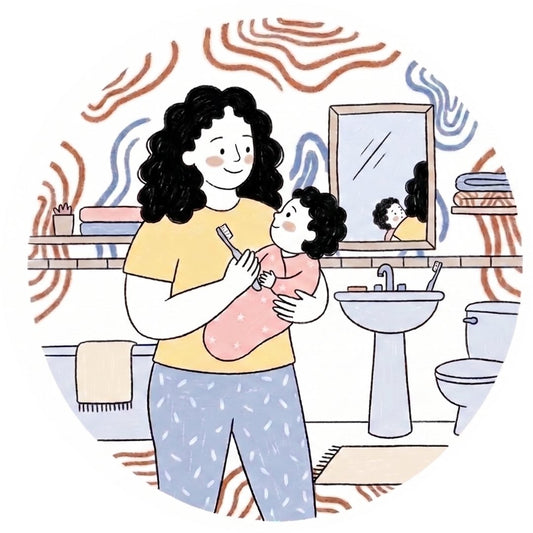
The first month with a newborn moves fast and slow at once. Feeds blur into naps, naps blur into more feeds, and somewhere in between, every parent asks the same question: am I doing this right? This piece walks through what genuinely matters in those first 28 days, from feeding cues and safe sleep to bonding, immunity, and the milestones worth paying attention to, so the essentials are clear without the noise.
Whether you're in the third trimester preparing for the weeks ahead, currently in the thick of the newborn phase, or trying to sort real guidance from the conflicting advice everyone seems to have an opinion on, this is written with you in mind.

Before You Read Further
This blog is general information, not a substitute for your paediatrician's guidance for your specific baby. If your baby has a temperature above 38°C or below 36°C, hasn't fed in over four hours, has fewer than six wet nappies a day after day five, or shows jaundice spreading to the palms or soles, contact your doctor right away. When something feels off, and you can't quite explain why, that instinct is worth listening to.
If you're still pulling your newborn setup together, Loopie's newborn essentials checklist is a useful place to start.
Why the First 28 Days Get So Much Attention
A newborn's body is doing more in this month than at almost any other point in life. Inside the womb, the baby never breathes on its own; oxygen comes through the placenta. The first cry after birth is what starts the shift: it helps clear fluid from the lungs and kicks off independent breathing.
Paediatrician and neonatologist Dr. Garima Mengi, who runs the clinic Kindercure and has cared for over 10,000 patients, unpacked this transition in conversation with Akriti Gupta on The Parent Code. "It is not just a cry," she said. "It is the first breath that helps the lungs start functioning properly." The baby's organs, particularly the liver, are still catching up too. An immature liver can't process bilirubin efficiently yet, which is why newborn jaundice shows up in so many babies during the first week.
Globally, WHO data shows the neonatal period accounts for a significant share of all deaths before age five, which is part of why this window gets so much clinical attention. It's also, per Dr. Garima, the period where getting a handful of basics right tends to make everything afterward easier.
Essential Newborn Care Practices
Feeding: Reading the Cues Before the Cry
Dr. Garima's biggest reframe on feeding is timing. Crying, she points out, is a late hunger cue, not the first one. Before a baby cries, there are earlier signals: mouth movements, rooting (turning the head and searching for the breast), and increased general activity. Catching these early tends to make feeds smoother, because the baby isn't already distressed by the time milk arrives.
Rini Goel, Loopie's Marketing Head, describes this as one of the biggest things she wishes someone had told her before her baby arrived. "Nobody really tells you what those first days are like," she says.
After a C-section, she could barely sit up, and still had to figure out colostrum, getting the baby to latch, when to pump, and whether the baby was actually getting enough milk. "Feeding was especially challenging because you don't know when the baby is hungry or why the baby is crying," she says, recalling how cluster feeding during growth spurts left her baby wanting milk back-to-back with no obvious explanation at the time.
That uncertainty didn't resolve quickly. "For the first three months, I felt completely unsure," Rini says. Much of it came down to not knowing whether her baby's stomach was full or how much milk she was even producing. "I had read about breastfeeding before delivery, but experiencing it firsthand was very different."

Her son was also flagged for a possible tongue-tie, which added another layer of doubt as she moved between lactation consultants trying to figure out whether he was latching correctly. It was only once a doctor reassured her that the goal was simply a fed baby, breast milk or formula, that the anxiety started to ease. By month four, she says, her confidence had genuinely caught up.
Once she understood the earlier hunger cues, feeding became easier to anticipate. "There was definitely a learning curve," she says, "because newborns feed very frequently but in very small amounts. Their stomach is extremely small, so it can feel like the baby isn't getting enough milk even when those small feeds are appropriate for that stage."
Dr. Garima's guidance reassures this: a newborn's stomach is genuinely tiny, almost the size of a cherry; frequent feeds are the norm rather than a sign something's wrong.
If breastfeeding isn't possible or doesn't continue as planned, formula feeding is a reasonable path forward. It provides nutrition, though it doesn't carry the same natural antibodies as breast milk. Dr. Garima was clear that the priority is a fed, thriving baby, not a specific feeding method.
Feeding also brings its own small quirks, like hiccups right after a feed, which are common and usually resolve on their own; this guide on newborn hiccups covers when they're worth a second look.
Rini also found that tracking feeds, naps, and diaper changes took away some of the guesswork. She used an app called Huckleberry through most of her son's first six months, logging every feed and nap to spot patterns rather than relying on memory alone. "That app was also a lifesaver," she says. "It helped us a lot with nap prediction, and tracking gave us a clearer picture of what was actually going on, rather than guessing."
Bonding Through Skin-to-Skin Contact
Skin-to-skin contact right after birth does more than feel nice. It helps regulate the baby's body temperature, stabilises breathing, supports early breastfeeding, and triggers oxytocin release, which strengthens the emotional bond between parent and baby.
The World Health Organization's guide on Kangaroo Mother Care recommends this practice for all newborns, not only premature babies, and encourages it to begin as early as possible after delivery.
Safe Sleep, Simplified
The sleep guidance Dr. Garima shares is straightforward: babies should sleep on their back, on a firm surface, without pillows, loose bedding, or soft toys nearby. This reduces the risk of Sudden Infant Death Syndrome (SIDS), a condition without one clear cause but with several known risk factors tied to unsafe sleep setups.
Co-sleeping is common in many Indian households, and Dr. Garima addresses it directly rather than dismissing it: families who choose to co-sleep need to be especially careful that the baby has their own safe space within the bed, free from pillows or anything that could cover the face.

Hygiene That Actually Protects
A newborn's immune system and skin barrier are both still developing, so hygiene isn't a formality here. Hand washing before handling the baby matters, whether you're a parent or a visitor. If bottle feeding, proper sterilisation is essential.
Comfort, Temperature, and Navigating Traditional Practices
Overheating is as much a concern as being too cold. Dr. Garima's rule of thumb is simple: if you're comfortable in a certain number of layers, your baby generally needs just one more. Overdressing a baby out of worry is a common instinct, but it isn't necessary, and it isn't better for them.
This is also the period where traditional practices and medical advice often sit side by side, sometimes in conflict. Rini followed the customary 40-day period of keeping her body warm and covered after delivery. "Initially, I didn't want to follow it, but eventually I realised that some of it did make sense, especially because the body is recovering after delivery," she says.
Carom-seed water and laddoos, commonly given after delivery, genuinely helped with post-surgery constipation for her. But she didn't follow every piece of advice that came her way: being told not to wash her hair for 40 days was one she disagreed with outright, feeling it was simply too long.
Food was another point of friction. Her doctor saw no issue with yoghurt or other traditionally "cold" foods, while family members advised against coconut water, cold tea, and ice cream. Her doctor's actual guidance leaned toward softer, easily digestible foods like khichdi, upma, and oats, useful given how common constipation is after delivery, rather than a blanket restriction on any single food.
The takeaway isn't that tradition or medical advice wins outright; it's that it's worth checking which parts of either genuinely serve you and your baby, and letting go of the ones that don't.
Premature Babies: What Changes
A baby born before 37 weeks is considered preterm or premature. Dr. Garima breaks this down further: extremely premature is under 28 weeks, very premature falls between 28 and 32 weeks, and late preterm is between 32 and 37 weeks. Generally, the earlier the birth, the longer the NICU stay and the higher the chance of complications, simply because organs need more time and support to mature.
Lungs are often the first concern. Premature babies may lack sufficient surfactant, a substance that helps the lungs expand properly, leading to what's called respiratory distress. Feeding is the next hurdle: the coordination needed to suck, swallow, and breathe together usually develops around 34 to 35 weeks of gestation, which is why oral feeding often can't begin until a baby reaches that stage.

When Can a Premature Baby Come Home?
Doctors typically look for a combination of factors before discharge: adequate weight (often around 1.8 kg or more), the ability to maintain body temperature without an incubator, stable breathing without oxygen support, consistent weight gain, and no recent episodes of apnea.
Just as important, according to Dr. Garima, is parental confidence. NICUs often practise "rooming-in," where the baby stays with the mother for a day or two before discharge, so parents leave feeling ready rather than anxious.
Building Immunity: Breastfeeding, Formula, and Beyond
Exclusive breastfeeding for the first six months, wherever possible, remains the strongest recommendation for immune support. Breast milk contains natural antibodies that formula simply can't replicate, along with complete nutrition for this stage. Formula feeding is a valid second option when breastfeeding isn't possible, offering solid nutrition even without the same antibody profile.
As babies grow, nutrition becomes a foundation for immunity in its own right. Dr. Garima's advice for building a plate once complementary feeding begins: think in terms of a rainbow. Fruits, seasonal vegetables, proteins, healthy fats, cereals, and legumes, all represented, rather than relying on any single food group.
Introducing Solid Foods and Handling Allergies
The old advice to delay allergenic foods until age one has changed. Current guidance favours introducing allergenic foods gradually, one at a time, typically starting around eight months, rather than avoiding them altogether.
Common allergens include nuts, eggs, cow's milk, fish, and shellfish. Whole nuts are a choking hazard and should never be given directly; almonds, for instance, can be powdered and mixed into food instead.
What Are the Signs of a Food Allergy in Babies?
Reactions usually appear within minutes to a few hours of eating a new food. Watch for skin rashes, hives, swelling around the lips, or difficulty breathing. If any of these appear, stop the food and speak to your paediatrician before reintroducing it.
Whether you lean toward purees or baby-led weaning, Dr. Garima's view is that both work, provided the food is age-appropriate and safe. Textures should have enough thickness to stay on a spoon rather than being watery, and any baby-led pieces should be soft enough to mash between fingers.
The goal in these early months isn't how much food gets eaten. It's building a relaxed, positive relationship with food, even when that means more mess than meal.

Growth Milestones
Dr. Garima anchors the milestone conversation around what's often called the first 1,000 days: the nine months of pregnancy plus the first two years after birth. Roughly 80 to 90 percent of brain development happens in this window, which makes it a period worth paying attention to, without turning every skipped nap into a crisis.
How Can Parents Support Baby Brain Development
The most effective stimulation isn't expensive toys; it's direct interaction. Talking, making eye contact, playing, and responding when a baby reaches out for attention all build new neural connections. Simply being present, rather than distracted, does more for early development than any product on the market.
Milestones span a few different areas: motor skills (head control, sitting, crawling, walking), language (recognising sounds, babbling, imitating voices), and emotional development (learning security through consistent, responsive care).
Tummy time plays a specific role in motor development, building the neck, back, and upper body strength a baby needs before sitting or crawling. Every baby moves through these at a slightly different pace, and that's expected rather than concerning.
Environmental Allergies: What to Watch For at Home
Allergic sensitivity isn't universal, even among children exposed to the same environment. Genetics and family history play a real role: a family history of dust allergy, asthma, or eczema raises the likelihood a child may develop similar tendencies. Common signs include repeated wheezing, sneezing after waking, a constantly running nose, and frequent eye or nose rubbing.
Indoor allergens are often more significant than outdoor pollution. Dust mites, which thrive in mattresses, pillows, and bedding, are a major trigger. Regularly washing bedsheets, keeping mattresses and curtains clean, and being cautious with stuffed toys can meaningfully cut down exposure.
Mould, indoor smoke, and strong-smelling cleaning products round out the list of common indoor triggers worth minimising, particularly for a child already showing allergy symptoms.
Choosing the Right Paediatrician
Dr. Garima describes the paediatrician relationship as a journey built on trust and continuity. A doctor who has followed a baby's history from the start understands what's typical for that specific child, which matters more than it might seem during a stressful late-night call.
Rini's experience backs this up in a very concrete way. Trust, for her, wasn't immediate; it built over time with one doctor who stood out for being straightforward and no-nonsense.
At a point when she was cycling through multiple lactation consultants over breastfeeding worries, he pointed out something that reframed the whole situation for her: when breastfeeding isn't going well, people often end up blaming either the mother or the baby. "That observation made us realise that many of the consultants were following a similar pattern of explanation and blame," she says.
That clarity, paired with his patience in answering every question without rushing her, is what built her trust. "That combination of experience, clarity, and patiently answering our questions is what built our trust in him," she says.
Look for a doctor who explains reasoning rather than just issuing instructions, is reasonably accessible for urgent concerns, and makes space for your questions without rushing through them. If a doctor consistently dismisses concerns or doesn't take time to explain the "why," it's worth considering a change.
Frequently Asked Questions
How do I know if my newborn is healthy?
Regular weight gain, adequate wet nappies, alert periods between feeds, and meeting basic reflexes are good signs. Your paediatrician's scheduled check-ups are the most reliable way to track this over the first month.
What temperature should a newborn's room be?
A comfortable, moderate room temperature works best, with baby dressed in roughly one more layer than an adult would wear in the same space. Checking the back of the neck, rather than hands or feet, gives a more accurate read on whether the baby is too warm or too cool.
When should I start solids for my baby?
Most babies are ready for complementary feeding around six months, alongside continued breastfeeding or formula. Readiness signs include sitting with support and showing active interest in food.
What are the most important things to focus on in the first 28 days?
Feeding on cue, safe sleep, skin-to-skin bonding, and basic hygiene cover most of what matters in this window. Getting these right tends to make the following months noticeably steadier.
Here's To New Beginnings!
There's no single right way to move through the newborn phase, and Dr. Garima's guidance keeps circling back to one idea: parents don't need to be perfect; they need to be present, informed, and willing to ask for help when something feels unclear.
Feeding will get easier. Sleep will find more of a rhythm. And the questions that feel enormous in week one tend to shrink with time and the right support around you.
There's no single right way to move through the newborn phase, and the guidance in this piece keeps circling back to one idea: parents don't need to be perfect; they need to be present, informed, and willing to ask for help when something feels unclear.
Feeding will get easier. Sleep will find more of a rhythm. And the questions that feel enormous in week one tend to shrink with time and the right support around you.