This guide explains how to protect your baby from high AQI: why little lungs are affected more, how to read the AQI, and what to do at home, outdoors, and at night. Winter brings a familiar dilemma. You want sunshine and fresh air for your baby, but the app says “Severe.”
Going outdoors is really important for your little one, as it provides necessary sensory stimulus for their growth. However, when the air around us gets highly polluted during winters, many parents are left wondering how to keep their baby safe.
You cannot fix the city’s air, but you can reduce what your baby breathes. In this read, you will find a simple AQI table, age-wise tips, and a daily routine. Most of these habits are free, and a few steady changes can make a real difference.

Why Does Winter Air Pollution Get Dangerous?
Winter air pollution in North India builds up when several sources add up at once. Traffic, construction dust, waste burning, industry, and crop-residue burning all release fine particles. Cold weather then holds those particles close to the ground, a pattern called temperature inversion.
Air pollution in Delhi-NCR is not limited to the city itself. Delhi is part of the larger Indo-Gangetic Plain, where pollutants can travel across state boundaries depending on wind direction and speed.
Emissions from neighbouring cities, industrial regions, agricultural areas and other parts of North India can contribute to the region's overall pollution load. This is why tackling Delhi's air pollution requires coordinated action across the entire region, rather than focusing on the capital alone.
However the Indian Academy of Pediatrics notes that air quality is usually worst in winter. It repeats every year, so you can plan for it.

Why Are Babies More Affected by Air Pollution?
Babies are more vulnerable to air pollution because they breathe more frequently, inhale more air relative to their body weight, and have developing lungs. There are four key reasons why their exposure and risk are higher:
1. Babies Breathe More Frequently
While a resting adult takes around 12–18 breaths per minute, an infant can take 40–60 breaths per minute. This means babies breathe much more frequently, increasing the amount of air, and potentially pollutants, they inhale throughout the day.
Unlike adults, they cannot easily move away from polluted air or tell you when something feels wrong. Together, these factors make babies more vulnerable to air pollution than adults.
2. They Inhale Twice as Much Air per Kilogram of Body Weight
Babies have a higher metabolic rate and faster respiration than adults. As a result, they inhale approximately twice as much air per kilogram of body weight. This means that, relative to their size, they can take in a significantly higher amount of airborne pollutants.
3. Their Breathing Zone Is Closer to Ground-Level Pollution
Babies spend much of their time in strollers, baby carriers or crawling on the floor. This places their breathing zone closer to the ground, where they may encounter vehicle exhaust, road dust and other ground-level pollutants.
Heavy particulate matter and certain emissions can accumulate close to the surface due to temperature inversion, making a baby's lower breathing zone an important consideration when stepping outdoors.
 In winters, layer of warm air sits above cooler air near the ground. This acts like a lid, trapping pollutants such as vehicle exhaust, dust and smoke close to the surface, where babies may be more exposed.
4. Their Lungs Are Still Developing
A baby's lungs are not fully developed at birth. The number of alveoli (tiny air sacs responsible for exchanging oxygen and carbon dioxide) increases significantly during early childhood. Exposure to fine particulate matter during this critical period may interfere with healthy lung development and affect long-term respiratory health.
Health Impact of Pollution on Children
In the short term, air pollution can irritate the eyes and airways, aggravate respiratory symptoms, and increase the risk of respiratory infections. But the bigger concern is prolonged exposure.
Research has linked air pollution to impaired lung development and an increased risk of respiratory problems later in life. According to the State of Global Air 2024 Report (HEI & UNICEF), air pollution contributed to over 460 deaths of children under five every day in India.


Divisha Jadhwani, a certified baby-and-child nutritionist and founder of Jars & Journeys, explains:
"Young children also breathe more through the mouth, and their noses filter air less efficiently. Their lungs, immune system, and brain are still developing."
"Because of this, air pollution is linked to worsening asthma and to problems with lung development and brain development. Babies with more daily pollution exposure have also been found more likely to need hospital care for bronchiolitis."
Her breathing figures match a 2011 Lancet review of normal ranges. The bronchiolitis link is still being studied, and some studies suggest an association. The encouraging part is that IAP notes that lung function can improve when air quality does.

How to Read AQI and Understand Air Pollution Levels
PM2.5 means fine particles of 2.5 micrometers or smaller, small enough to travel deep into the lungs.
The AQI is a planning tool, not a personal reading. Pick the nearest monitoring station and watch the trend, since a city-wide average can hide big differences. Use CPCB or the SAMEER app for live readings, and SAFAR for forecasts where your city is covered.
People's health may be affected according to the various AQI category levels, depending on the vulnerability and hazard exposure.
CPCB’s bands tell you how polluted the air is. GRAP, the Graded Response Action Plan, tells you what authorities do once the NCR’s AQI crosses set thresholds, as set out in CAQM’s revised GRAP schedule of September 2026.
AQI levels for babies: What to do
|
CPCB AQI |
CPCB category |
GRAP stage (Delhi-NCR) |
What to do with your baby* |
|
0 to 50 |
Good |
None |
Normal routine and outdoor time. |
|
51 to 100 |
Satisfactory |
None |
Normal routine; shorter outings if your baby has respiratory issues. |
|
101 to 200 |
Moderate |
None |
Caution zone for infants: avoid traffic-heavy routes, no strenuous outdoor play. |
|
201 to 300 |
Poor |
Stage I |
Keep outdoor time short and only when needed; protect the sleep room. |
|
301 to 400 |
Very Poor |
Stage II |
Stay indoors; skip parks, walks, and outdoor play; windows closed if outdoor air is worse; run the purifier. |
|
401 to 500 |
Severe |
Stage III (401 to 450); Stage IV, Severe+ (above 450) |
Maximum indoor protection; postpone travel. |
Source: AQI categories are based on the Central Pollution Control Board’s National Air Quality Index. GRAP stages apply to Delhi-NCR and adjoining areas under the Commission for Air Quality Management’s September 2026 revised schedule
How to Create a Clean and Safe Indoor Environment for Your Baby
Start with the sleep room, where your baby breathes the same air for the longest stretch, and you have the most control over indoor air quality for infants.
Many homes light camphor or dhoop for a calm, fragrant feel. It smells lovely, but burning adds smoke and particles to the room, which is why IAP suggests avoiding incense sticks and mosquito repellents. Likewise, a window flung open for fresh air on a smog day lets the smoke in, so wait for the AQI to improve.

Here is a home checklist for new parents:
- Keep windows shut during peak pollution hours, and open them briefly when the AQI drops, usually around midday.
- Run a HEPA air purifier in the room where the baby sleeps and spends most of their time, and change the filters on schedule.
- Avoid incense, dhoop, mosquito coils, candles, and smoking indoors.
- Use the kitchen exhaust while cooking, especially for tadka and frying, and keep the baby away from the kitchen.
- Clean with a damp mop rather than a dry broom, so dust doesn't fly back into the air.
- From a nutrition side: continue breastfeeding where possible, keep babies on solids well hydrated, and include vitamin C-rich fruits and vegetables like amla, orange, guava, and tomato in age-appropriate forms. Good nutrition supports a baby's overall health, but it does not replace clean air.

Choosing a HEPA Air Purifier for the Baby’s Room
IAP recommends HEPA-fitted purifiers with a high clean air delivery rate (CADR), kept clear of furniture and walls, and cautions against purifiers that produce ozone. A purifier cannot clean a poorly sealed home or remove smoke created indoors.
Anmay Shahlot, an IIM Indore alumnus and co-founder of Atovio (a D2C health-tech startup making portable and wearable air purifiers for India’s pollution crisis), suggests four checks before trusting any purifier claim:
Filtration
Ask for independent lab results and the test conditions. Ask every brand, ours included, for the same.
Safety
Ask for ozone test data on any ionising purifier, and check for cords, small parts, and age guidance.
Noise
Ask for the decibel level.
Results
Trust “up to” and honest test conditions. Run from “100% protection” and any health-cure promises.

Build a Daily AQI Routine for Your Baby
Step 1- Open CPCB or the SAMEER app, pick the nearest station, and note the AQI, time, and trend.
Step 2 - Check SAFAR’s forecast if your city is covered. In Delhi-NCR, check the GRAP stage on the CAQM website.
Step 3 - Match the AQI to the table above: normal day, limited-outdoor day, or indoor day.

How to Protect Your Baby When Going Outdoors
Always check the local AQI levels and pollution forecasts first. In winters, choosing the right time for outdoor activities can help reduce your baby's exposure to harmful pollutants.
-
Avoid Non-Essential Outings: When AQI levels in your city are between Poor to Very Poor, limit unnecessary outdoor trips with your baby. Reschedule errands, avoid crowded outdoor spaces, and opt for indoor activities wherever possible.
Avoid Early Mornings and Late Evenings: These periods can experience higher pollution concentrations due to temperature inversion, which traps pollutants closer to the ground.
-
Plan Outdoor Walks Between 12 PM and 3:30 PM: If an outdoor walk or some sunlight is necessary, consider this window, when stronger sunlight and atmospheric mixing may help disperse ground-level pollutants.

Quick Tips If You Have to Take Your Baby Outdoors
- Keep trips short, go by car where possible with the windows up and the AC on recirculate, and stay away from busy roads and construction sites.
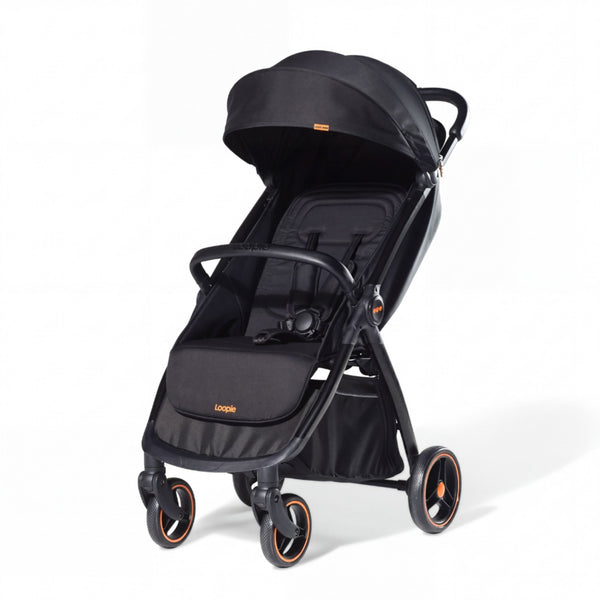
- Use the stroller cover, and remember that small children breathe at a height close to the ground, where many pollutants are more concentrated.
- When you get home, wipe the baby's face and hands and change their clothes.

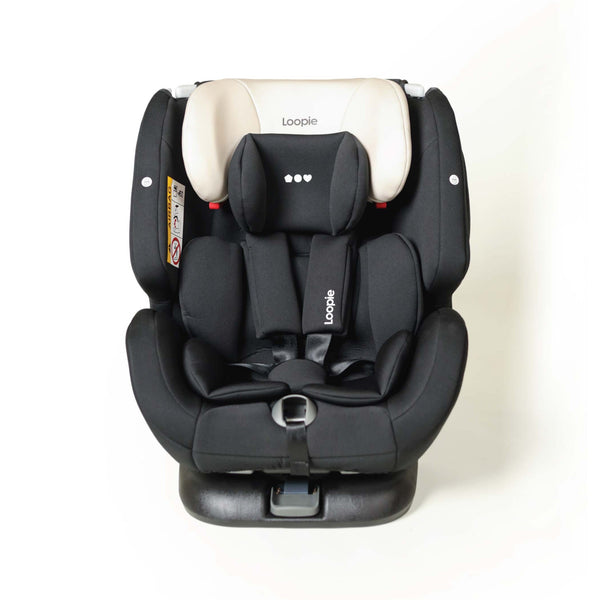
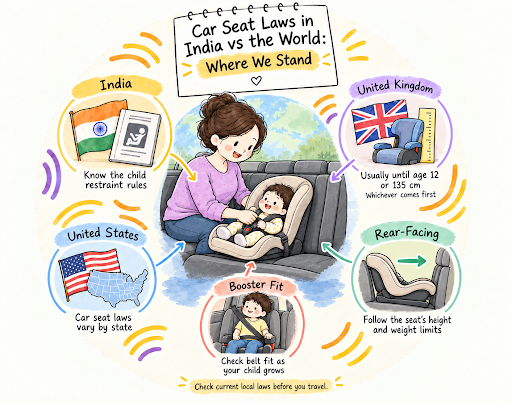
A stroller cover helps with wind and dust, but it isn't a filter, including the rain cover that comes as a separate accessory with the Loopie Hop stroller. In a car, windows up and recirculation mode are the basics, and a properly fitted car seat matters as much.
Short, well-timed trips still count, and our tips for keeping your baby warm in a stroller help on the chilly mornings.

Should Babies and Toddlers Wear Masks Against Air Pollution?
Not under two, and never during sleep at any age. Mask at this age pose a choling and suffocation risk. Additionally, cloth masks, scarves and dupattas do not reliably filter fine particles either. From age two, a well-fitted mask may help on short, unavoidable trips, with an adult watching.
- From age two, a well-fitted child-size mask can help on short trips, with an adult always watching. Remove it for naps.
The American Academy of Pediatrics adds that a well-fitting N95 respirator protects better than a medical mask, but a snug fit is hard on small faces, so ask your paediatrician.

Many parents also wonder whether a wearable air purifier can stand in for a mask. Here's what Anmay says about wearable purifiers:
"People assume wearable purifiers don’t work. In most indoor conditions, they do. A wearable cleans the air right where a child breathes, which is where air quality matters most, and it goes wherever the child goes: the car, the classroom, the playroom. It’s meant to be the first layer of defence, not the only one. It is not a replacement for a mask, and it is not for babies or toddlers under 4. For them, we say plainly: don’t use a wearable."
Atovio’s own wearable, Nino, is designed for children aged 4 and above, he says, so read this as an industry view and apply the same four checks. Either way, a mask or wearable is a backup; clean indoor air and short outings do the heavy lifting.

How to Protect Your Baby from Air Pollution at Different Ages
The core habits stay the same; outdoor time changes with each stage:
|
Age |
Main focus |
What is different |
|
Newborn to 6 months |
Maximum indoor protection. |
Outdoor time only when essential; keep away from all smoke; watch feeding, breathing, and sleepiness closely. |
|
6 to 12 months |
Protect sleep; allow short clean-air outings. |
Short outings on better-AQI days; avoid crowded indoor spaces if unwell. |
|
1 to 3 years |
Reduce outdoor play intensity, not movement. |
Swap outdoor running and jumping for indoor movement on poor-AQI days; start the habit of checking the air before going out. |
Source: Editorial framework based on WHO and UNICEF guidance on children’s vulnerability to air pollution. Not an official medical classification.
Indoor swaps that work: crawling tracks, soft play, music and sensory play. Age is a guide; the day’s AQI and your paediatrician’s advice come first.

What Should Parents Watch Out For During High-Pollution Days?
Symptoms of air pollution exposure in babies can include a cough that lingers, noisy breathing, poor feeding, or unusual sleepiness. Because babies cannot describe how they feel, changes in their usual behaviour are the clue.
These signs do not always point to pollution. Our guide to handling cough and cold in babies covers everyday coughs and colds. If something feels off, call your paediatrician. Divisha shares what to look for, and when to see a doctor if you notice any of these:
- A cough that doesn't settle.
- Wheezing or noisy breathing.
- Frequent sneezing or a blocked nose that's getting worse.
- Watery or red eyes.
- Poor feeding or unusual crankiness.
- Symptoms that don't improve in cleaner air.

A baby can't tell you their chest feels tight, and early signs of breathing trouble in the first year are easy to miss. Go to the doctor or emergency room right away if you see:
- Very fast breathing.
- The skin pulling in between the ribs or below the neck with each breath.
- Flaring nostrils.
- Bluish lips.
- Unusual drowsiness.
- Refusing feeds.
Divisha further explains, “Any breathing difficulty in a baby under three months needs urgent attention. Babies with asthma, a history of prematurity or frequent chest infections need extra care, so parents should agree on a plan with their paediatrician for high-AQI days".

The American Academy of Pediatrics also lists burning or stinging of the nose, throat and eyes among smoke effects in children. For emergencies, the Indian Academy of Pediatrics’ guideline on severe asthma flare-ups, which names pollution as a trigger, lists blue lips, nostril flaring, straining chest muscles and being unable to feed normally as signs to seek urgent care.

What Are Authorities Doing About Air Pollution?
Several bodies manage India’s air quality. The Central Pollution Control Board (CPCB) monitors the National Air Quality Index (AQI), while the Indian Institute of Tropical Meteorology (IITM) and the India Meteorological Department (IMD) provide forecasts through SAFAR, the System of Air Quality and Weather Forecasting and Research. The Commission for Air Quality Management (CAQM) coordinates action across Delhi-NCR and adjoining areas.
CAQM runs the Graded Response Action Plan (GRAP), which tightens restrictions as AQI worsens, from Poor at 201 to Severe+ above 450. It can act in advance based on forecasts. GRAP reduces additional pollution, but it cannot instantly clear what winter weather has already trapped. That is why a home routine still matters.
Spotted open waste burning, uncovered construction dust, or generator smoke? CPCB’s SAMEER app lets you report it with a photo and location. Reports do not guarantee action, but they build a record that supports follow-up.

FAQs: Parents’ Most Asked Questions on High AQI
Is high AQI dangerous for newborns?
It can be, because newborns breathe faster and their lungs are still developing. Keep them indoors on poor-AQI days and call your paediatrician if their breathing seems different.
What AQI is safe for babies?
Up to 100 is suitable for a normal routine. From 101 to 200, take care; from 201 upward, keep outings short and essential. See the AQI table above for more information.
Can I take my baby out when AQI is above 200?
Only when needed and for a short time, with windows up and recirculation on in the car. If it's above 300, stay indoors.
Can babies wear masks?
Not under two, and never during sleep. From age two, a well-fitted child-size mask can help on short trips, with an adult watching.
Does an air purifier help babies?
A True HEPA purifier sized for the room helps in a closed sleep room. It cannot clean outdoor air or smoke made indoors.
Keeping Li’l One Safe and Protected
You cannot control the city’s air, but you can shape what your baby breathes, one small decision at a time. Checking the nearest AQI station can become as routine as checking the weather.
Keep the AQI table and the daily routine handy through the high-pollution months. This guide offers general information, so always chat with your paediatrician about your baby’s needs.