Montessori education has become one of the most sought-after approaches in urban cities and beyond. Parents are drawn to its promise of independence, deep learning, and joyful discovery, which is quite different from the rote memorization many of us grew up with.

But what exactly are the benefits of Montessori learning? How is it special? And how do Montessori toys support child development differently than the battery-operated gadgets flooding our markets?
This guide breaks down the research-backed benefits of Montessori education, explains what makes Montessori toys unique, and offers practical tips for bringing Montessori principles into Indian homes.
Disclaimer: This information is general guidance, not professional advice. Every child develops at their own pace. For specific concerns about your child's development or education, consult certified Montessori educators or your pediatrician.

Who this blog is for
This guide is designed for:
-
Parents exploring Montessori for children aged 0-6 years
-
First-time parents navigating different educational approaches
-
Families wanting to implement Montessori principles at home
-
Anyone curious about how Montessori toys differ from conventional options
-
Indian parents seeking culturally relevant ways to support child development
-
Whether you're considering Montessori schools in India or simply want to support your child's growth and development at home, this is your starting point.

What is Montessori Learning
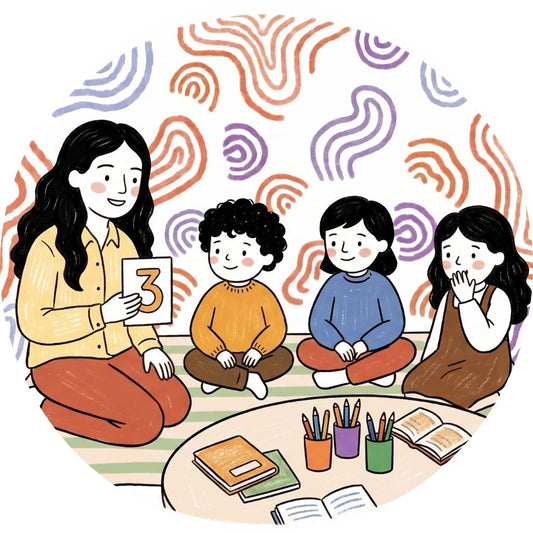
Montessori education is a method of learning built around children choosing their activities, exploring through touch and experience, and learning alongside others. It respects that every child is different, supporting their natural growth in academics, emotions, and social connections.
Montessori education was developed by Dr. Maria Montessori in early 1900s Italy. At its heart lies a simple belief: children are naturally curious and capable. The adult's role isn't to force-feed information but to prepare an environment where discovery happens naturally.

The Association Montessori Internationale describes authentic Montessori programs as having several key characteristics: freedom within limits, mixed-age classrooms (typically 3-year spans like 3-6 or 6-9), hands-on learning materials, and uninterrupted work periods of 2.5-3 hours. The teacher guides rather than directs.
This child-directed learning approach stands in stark contrast to traditional teacher-centered methods. Instead of all children doing the same worksheet at the same time, a Montessori classroom hums with individual choice - one child pouring water, another building the pink tower, a third tracing sandpaper letters.
The shift matters because it develops not just academic skills but independence, concentration, and intrinsic motivation - qualities that serve children throughout life.

How Montessori Education came to India
Montessori arrived in India during the 1940s-50s, introduced by educators who'd encountered it abroad. Early schools popped up in major metropolitan areas, mostly serving progressive urban families.
The 1980s-90s saw growth of AMI-recognized training centers in India. By the 2000s, Montessori schools in India had expanded significantly, becoming mainstream in urban areas. Today, India has numerous AMI-recognized training centers and hundreds of Montessori programs, though quality varies significantly across institutions.

What makes Montessori work well in Indian contexts? The principles align beautifully with traditional values: respect for elders, community living, practical life skills. Schools often integrate Indian cultural elements: festivals, regional languages, traditional activities like rangoli or roti-making. It's Montessori with an Indian soul.

What are the benefits of Montessori Learning
1. Deep understanding over memorization
Montessori materials are brilliantly designed to make abstract concepts concrete. Children handle golden beads to understand the decimal system physically before seeing numerals written. They trace sandpaper letters with their fingers before writing.
As highlighted by research on Montessori toys, these materials facilitate hands-on learning through tactile experiences rather than passive observation. Children explore concepts by manipulating physical objects, building neural connections that support deep understanding.

The result? When understanding finally clicks, it's profound and lasting. A child who's physically combined bead groups dozens of times knows why 5 + 3 = 8, not just memorizes it. This foundation supports everything from competitive exam preparation to real-world problem-solving later.
2. Enhanced focus and concentration
In a world of constant notifications and distractions, Montessori's uninterrupted work periods train young minds to sustain attention. Even preschoolers can focus for 30+ minutes when engaged with materials matching their interests.

This isn't about forcing attention, it's about respecting it. When a child is deeply absorbed, no adult interrupts with praise or suggestions. The concentration builds naturally, developing executive function skills that research increasingly recognizes as crucial for school readiness and long-term academic success.
3. Independence and self-confidence
Watch a 3-year-old in a Montessori environment pour water without spills, button their own shirt, or prepare a simple snack independently. These aren't party tricks—they're building blocks of confidence.

The self-correcting nature of Montessori materials, as noted by Montessori education experts, empowers children to learn from mistakes without external judgment. This builds resilience and problem-solving skills organically.
That "I can do it myself" mindset extends far beyond practical tasks. It becomes a core belief: I am capable. In Indian homes where children are often helped extensively by parents, grandparents, or domestic help, this independence stands out—and serves them for life.
4. Intrinsic Motivation
No gold stars. No prizes for finishing work. No comparison charts on the wall.
Montessori children work for the satisfaction of mastery itself. Educational research on motivation suggests that learning driven by internal satisfaction supports deeper, more sustained engagement than working for external rewards like stickers or grades.

This matters enormously in India's often highly competitive educational culture. While external rewards dominate traditional schools, Montessori offers a different path: learning because it's inherently satisfying.
5. Social and Emotional Growth
Mixed-age classrooms create natural mentorship. Younger children observe older peers and absorb skills through watching. Older children develop empathy and leadership by helping younger ones.

Conflict resolution is taught explicitly: how to wait for a turn, offer help, use words to solve problems. Grace and courtesy lessons make social-emotional learning concrete, not abstract.
For child development in social contexts, this approach is invaluable. Children learn to navigate relationships cooperatively rather than competitively.
6. Strong Academic Foundations
The hands-on approach to mathematics and language creates solid foundations. Mathematical concepts that confuse traditionally-taught children make intuitive sense to Montessori learners who've physically manipulated quantities.
Language develops through multi-sensory experiences: tracing letters, building words with moveable alphabets, engaging with rich vocabulary in meaningful contexts.

Important context for Indian parents: Montessori children may appear behind at ages 3-4 compared to traditional school peers memorizing letters. This is intentional—deep foundations are being built. Many Montessori educators observe that children often demonstrate solid academic skills by ages 5-6, with thorough understanding of concepts rather than surface memorization.
7. Physical Development
Fine motor skills refine through daily practical life activities: pouring, transferring with tongs, cutting with child-safe scissors. These seemingly simple tasks develop hand-eye coordination that supports later writing and detailed work.

Gross motor development happens through outdoor exploration, gardening, and movement activities. Research on Montessori education in India emphasizes that natural materials and outdoor experiences are central to holistic child development.
What makes Montessori Toys different?
Montessori toys are simple, purposeful play materials (often made from natural wood or fabric) designed to encourage hands-on, child-led exploration and skill-building.
Not every wooden toy qualifies as a Montessori toy. Authentic Montessori materials have specific design principles.
1. Isolation of Concept
Each material teaches one skill at a time, preventing cognitive overload. The pink tower focuses solely on size discrimination - all cubes are identical except size. No colors, patterns, or numbers distract from understanding big versus small.
Montessori toy research shows that focusing on a single skill or concept prevents cognitive overload and allows for deep engagement with each learning objective.

2. Control of Error
Materials are self-correcting. Puzzle pieces don't fit if placed wrongly. Liquid overflows if poured carelessly. The tower topples if not balanced properly.
Children discover mistakes themselves, learning to self-correct without adult intervention. This builds problem-solving abilities and resilience which are essential components of growth and development.
3. Natural Materials
Studies on sustainable Montessori toys highlight that materials like wood, cotton, and metal are not only eco-friendly but offer varied sensory experiences that plastic cannot replicate.

Different textures, weights, and temperatures refine sensory awareness. A wooden block feels and weighs differently than plastic - this matters for developing brains making sense of the physical world.
4. Purposeful Design
Montessori toys are beautiful, well-crafted, and based on real-life activities. A child-sized pitcher isn't a toy—it's a functional tool. This grounds learning in reality, preparing children for actual life, not fantasy play.
5. Open-Ended Exploration
Unlike battery-operated toys that do things to children, Montessori materials require active engagement. The child controls the activity entirely, encouraging creativity within structure.

Selecting Age-Appropriate Montessori Toys
Birth to 12 Months
-
Simple grasping materials (wooden rings, soft rattles)
-
Object permanence boxes
-
Floor mirrors for self-discovery
-
Fabric books with real images
12-36 Months
-
Practical life materials: pouring sets, transfer activities, stacking toys
-
Simple knobbed puzzles (1-5 pieces)
-
Sound matching containers
-
Push/pull toys
3-6 Years
-
Advanced practical life tools for food prep and cleaning
-
Building blocks and construction materials
-
Art supplies: watercolors, clay, child-safe scissors
-
Nature exploration tools like magnifying glasses
For Indian contexts: Adapt with cultural materials - small rolling pins for roti-making, rangoli materials, items for festival preparations, traditional musical instruments like small tabla or manjira.
Quality indicators: Look for smooth, splinter-free wood, non-toxic finishes, sturdy construction, and simple, beautiful design. Local carpenters can create many basic items affordably.
What to avoid: Overstimulating battery-operated toys, cheap plastic that breaks easily, cartoon character-based items for very young children, toys with no clear learning purpose.

Are there any recommendations for Montessori Toys?
Here are some great Montessori toy recommendations, focusing on authentic, child-led options popular in India (mostly wooden, sustainable, and development-focused):
-
Ariro Toys- Neem wood teethers, tummy time mobiles, and push-pull toys for infants/toddlers are considered safe and natural.
-
Curious Cub- Activity boxes, Pikler triangles, and play furniture for 0–6 years are trusted by many Indian parents.

-
Shumee- Open-ended wooden puzzles, sorting toys, and practical life items for ages 1–6.
-
Eduspark Toys- Made-in-India Montessori sets for literacy, numeracy, and fine motor skills.
-
Bombay Toy Company- Eco-friendly open-ended toys inspires independence in toddlers/preschoolers.
These brands emphasize natural materials and purposeful play that is perfect for home use!

How to set up a Montessori at home: Practical Tips for Indian Parents
1. Create a Prepared Environment
Organization is key. Use low, accessible shelves at your child's height. Open shelving works better than toy boxes, and remember children need to see choices clearly.
Display 5-10 items at a time and rotate weekly to maintain interest. Each item should have a specific place. This visual order helps children develop organizational skills naturally.
Indian home adaptation: Convert lower cabinet shelves, use available stools with baskets, or install simple low shelves. Even small spaces can work; dedicate one corner as your child's workspace.

2. Use Real, Functional Items
Indian households already have excellent Montessori materials: stainless steel bowls for nesting and transfers, kitchen spoons, small rolling pins, serving utensils.
Let children use real glass cups (supervised initially), actual cleaning supplies (child-sized broom available in local markets), and functional tools. Yes, things might break, and that's a learning opportunity about care and consequences.

3. Follow Your Child's Lead
Observe what fascinates your child and offer related materials. If they love pouring, provide multiple pouring activities with different containers, liquids, and solids.
Resist interrupting focused work. When a child is deeply concentrated, no helpful suggestions or praise are needed. Let them complete the full activity cycle independently.
4. Embrace Repetition
Children may repeat the same activity 20, 30, even 50 times. This isn't boredom - it's mastery-building. Trust that your child will move to something new when internally ready.

5. Limit Screen Time
Montessori philosophy strongly advocates minimal screens, especially for children under 6. Active hands-on experiences develop the brain in ways passive watching cannot.
This is challenging in Indian households with family TV, relatives' smartphones, and YouTube's pull. Set consistent boundaries and provide engaging alternatives - when materials are accessible and interesting, children naturally choose active play.
Health experts recommend limiting screen exposure for young children to support active play and development. Discuss appropriate limits with your pediatrician based on your child's age and individual needs.

6. Model Independence
Children learn through observation. Model putting things away, working with focus, problem-solving aloud, and caring for your environment. Your actions teach more than words.
You may also like our guide on the Role of Sensory Books in Baby’s Early Growth.

Frequently Asked Questions
At what age should I start Montessori principles?
Montessori can begin from birth through movement freedom and sensorial exploration. Formal programs typically start at 2.5-3 years. Consult your pediatrician about developmental readiness for your specific child.
Are Montessori toys better for child development than regular toys?
Research on Montessori materials shows these toys promote active learning, problem-solving, and independence through self-correcting, purposeful design. However, children benefit from varied play experiences. Focus on quality over quantity and ensure most toys encourage active engagement rather than passive entertainment.
Can I practice Montessori at home without attending Montessori schools?
Absolutely. Core principles - child-accessible environments, practical life activities, following interests, using natural materials - work at home regardless of school choice. Many families successfully incorporate Montessori principles into daily routines without formal schooling.
Do I need expensive branded materials?
No. Simple household items and natural materials provide excellent learning opportunities. Local artisans can create basic wooden materials affordably. Focus on real, purposeful items from daily life rather than expensive imports.
Will sustainable Montessori toys work in Indian households?
Yes. Studies on Montessori in India show that sustainable materials align perfectly with traditional Indian values and adapt easily to local contexts. Use items like dal for sorting, small kitchen tools, garden materials, and regional craft supplies.
How do I transition a screen-dependent child?
Gradual reduction works better than sudden elimination. Provide engaging hands-on alternatives, spend time together in activities, and maintain consistent limits. Consider consulting your pediatrician for age-specific guidance on appropriate screen time limits for your child's developmental stage.
How do I know if a Montessori school is authentic?
Look for AMI or AMS certified teachers, authentic Montessori materials (not just wooden toys), uninterrupted work periods of 2.5-3 hours, mixed-age classrooms, and environments where children choose activities independently. Visit schools, observe classes, and ask about teacher training credentials.
Can Montessori work with Indian joint family structures?
Yes, though it requires family alignment on key principles like allowing independence and avoiding constant helping. Education and open conversation with extended family members help. When grandparents see children's growing competence, they often embrace the approach.

The future of Montessori
Montessori education offers Indian families a research-backed approach emphasizing independence, deep understanding, and joyful learning. The benefits of Montessori learning extend beyond academics to social-emotional skills, practical competence, and intrinsic motivation—qualities that serve children throughout life.
Montessori toys differ fundamentally through self-correcting design, natural materials, and purposeful learning objectives. Research from educators and child development specialists confirms these materials support growth and development through hands-on exploration and sustainable design principles.
Parents can implement Montessori principles at home using household items, organizing child-accessible spaces, and respecting children's natural learning rhythms. For personalized guidance for your child, consult certified Montessori educators and your child's pediatrician.